Medical Weight Loss in Denver, CO
Physician-Guided Results
Injectables & Advanced Therapies
Achieve sustainable weight loss with our medically-supervised programs combining advanced pharmacologic therapies and personalized care.
Losing weight is one of the most challenging health goals — especially as you age. Metabolism slows, hormones shift, and the strategies that worked in your 20s simply don't deliver the same results. Willpower and diet alone are often not enough when your biology is working against you.
At R2 Medical Clinic, our physician-supervised weight loss programs combine advanced pharmacologic therapies with personalized medical protocols and ongoing monitoring to help you achieve sustainable, medically-guided results.
All treatments require a medical evaluation and prescription by a licensed provider. Individual results vary.
Health Risks of Excess Weight
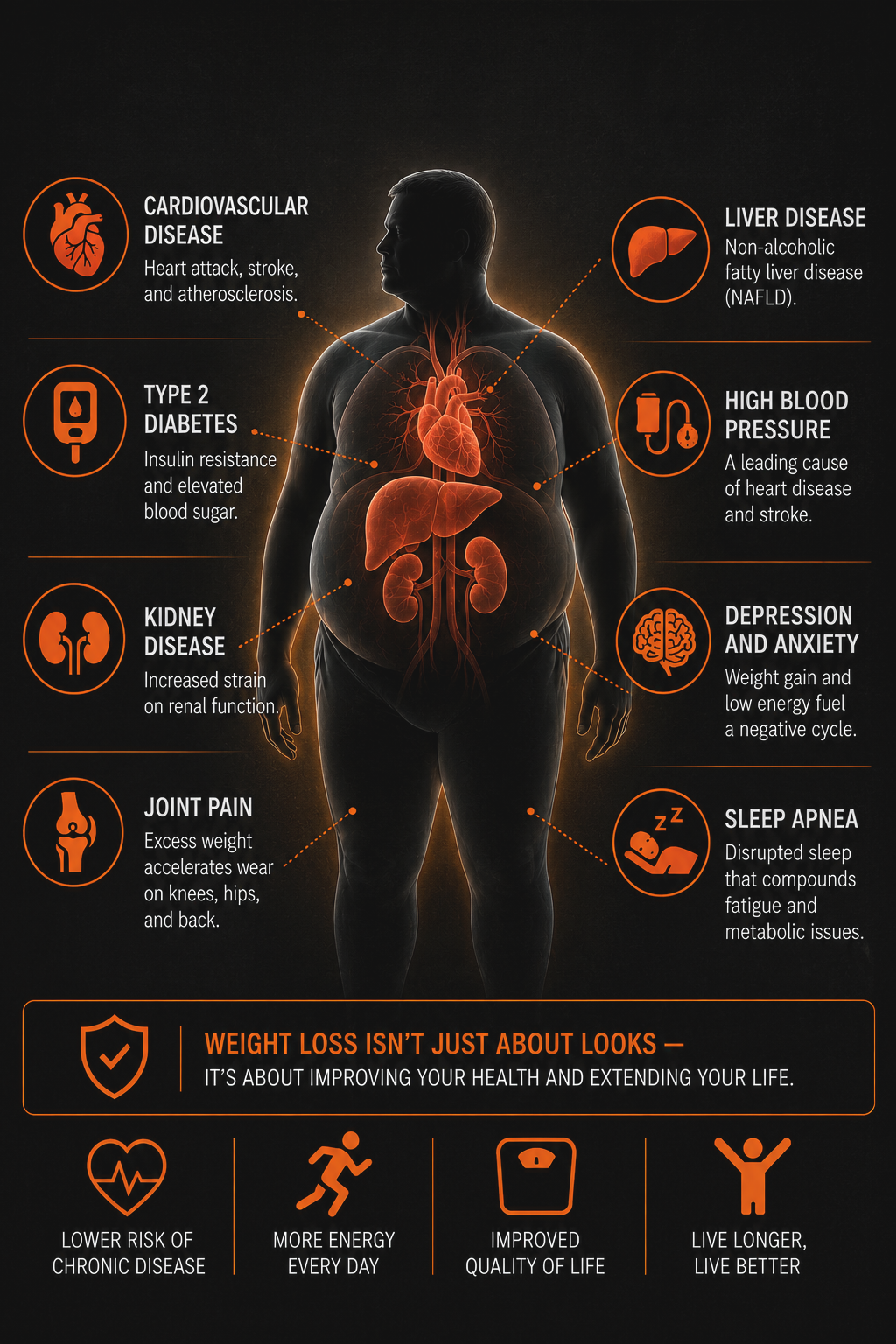
Carrying excess weight significantly increases your risk for a wide range of serious medical conditions, including:
- Cardiovascular disease — heart attack, stroke, and atherosclerosis
- Type 2 diabetes — insulin resistance and elevated blood sugar
- Kidney disease — increased strain on renal function
- Liver disease — non-alcoholic fatty liver disease (NAFLD)
- High blood pressure — a leading cause of heart disease and stroke
- Depression and anxiety — weight gain and low energy fuel a negative cycle
- Sleep apnea — disrupted sleep that compounds fatigue and metabolic issues
- Joint pain — excess weight accelerates wear on knees, hips, and back
Medical weight loss isn't just about changing the number on the scale. Achieving and maintaining clinically meaningful weight loss can improve many obesity-related health risks and measures of metabolic health.
Why Weight Loss Gets Harder After 35
Most patients who come to us have already done the obvious things. They've cut calories, added cardio, tried intermittent fasting, and watched the scale barely move. When weight loss stalls despite sustained effort, physiology may be part of the explanation — and many contributing factors can be evaluated objectively.
As you get older, several things can change at once. Lean muscle mass tends to fall, which lowers the number of calories your body burns at rest. Insulin sensitivity can decline. And sex hormones shift — testosterone in men, and estrogen and progesterone through perimenopause and menopause in women — which can affect where the body stores fat. Which of these apply to you is a question your lab work answers, not something to assume.
How We Approach It
This is why a program built on a single number — calories — so often fails. A physician-supervised program starts by measuring which of these factors are actually present in you, then treats those specifically. If thyroid dysfunction, testosterone deficiency, insulin resistance, or another metabolic issue is present, identifying and appropriately addressing it may be an important part of a comprehensive weight-management strategy. Those need to be identified and addressed on their own terms, which is why our weight loss evaluation includes a full hormone panel rather than a weigh-in.
What a Physician-Supervised Program Actually Includes
"Medical weight loss" is used loosely, and plenty of programs that use the phrase are really a subscription and a prescription. Here is what is included at R2 Medical Clinic, so you can compare directly:
A Full Medical Evaluation
Health history, current medications, prior weight loss attempts, and the reasons previous efforts stalled.
Comprehensive Lab Work
Comprehensive labs, metabolic panel, lipid profile, HbA1c, fasting insulin, and a hormone panel covering thyroid, testosterone, estrogen, and progesterone.
A Protocol Chosen for Your Results
Therapy and dosing selected by a licensed provider based on your labs, not a standard package.
Scheduled Follow-Up
Regular follow-up appointments to track progress, adjust dosing, and ensure your safety throughout the program.
Every therapy we offer requires a medical evaluation and a prescription from a licensed provider.
A Multi-Modal Approach to Medical Weight Loss

Nutrition & Diet Support
Sustainable dietary strategies based on health, metabolism and goals.
Exercise & Muscle Preservation
Resistance training and appropriate cardiovascular activity to support fat loss, preserve lean mass and improve metabolic health.
Oral Medications
Prescription options for appetite, cravings or other appropriate indications.
Injectable Medications
Physician-prescribed injectable therapies when clinically appropriate.
Peptide Therapy
Selected therapies considered based on goals, clinical circumstances and available evidence.
Hormone Optimization
Evaluation and treatment of clinically relevant hormone abnormalities when present.
Our Pharmacologic Options
R2 Medical Clinic offers several physician-prescribed treatment options that may be considered as part of an individualized weight-management program. The evidence, indications, risks, and expected benefits vary by therapy:
Injectable Weight Loss Medications
These medications work by reducing appetite, slowing gastric emptying, and improving blood sugar regulation.
Peptide Therapies
Certain peptide therapies may be considered in selected patients based on individual goals, clinical circumstances, and available evidence.
Oxytocin
May be considered in select circumstances as part of an individualized treatment plan; its role in weight management is still being studied.
Naltrexone
When combined with other agents, naltrexone can help reduce food cravings and compulsive eating behaviors.
FDA-Approved Appetite Management
Physician-selected options that can support appetite control in appropriate candidates.
How Weight and Hormones Interact
Weight and hormone health are often related rather than separate issues. In men, body fat is a site where testosterone is converted to estrogen, so body composition and hormone levels can influence one another. Low testosterone is also associated with reduced lean muscle mass. This is part of why our weight loss evaluation includes a hormone panel rather than looking at weight alone.
Related Therapies
For men, that often means evaluating weight loss alongside testosterone replacement therapy, where lab work shows a deficiency and a provider determines it is appropriate.
For women, perimenopause and menopause can affect body composition and where fat is stored. Where appropriate, bioidentical hormone replacement therapy is evaluated alongside the weight loss protocol rather than after it.
Some patients also benefit from peptide therapy to support fat metabolism and lean muscle preservation. Whether any of these apply to you is determined by your lab results and evaluation — not assumed at the outset.
Your First Visit: What to Expect
Your first appointment is a consultation and work-up, not a sales visit. Nothing is prescribed before the provider discusses results, your goals, your expectations, and agreement on an appropriate weight loss regimen.
Step 1 — Consultation
Your health history, what you have already tried, and what you want to achieve.
Step 2 — Lab Work
Lab work. A comprehensive metabolic panel, lipid profile, HbA1c, fasting insulin, and a hormone panel covering thyroid, testosterone, estrogen, and progesterone.
Step 3 — Results Review
Your provider reviews your results with you and explains which options are appropriate for your profile.
Step 4 — Your Plan
A customized protocol built around your results, with follow-up appointments to track progress and adjust dosing.

R2 Medical Clinic is a private-pay clinic. Pricing is given to you up front, before you commit to anything. Call (720) 640-2333 for current pricing.
Medical Weight Loss vs Commercial Diet Programs
Many commercial programs focus primarily on caloric intake and behavior, while a physician-supervised medical program can also evaluate metabolic, hormonal, and other medical contributors to weight management.
- Diagnosis before treatment. A commercial program assumes the problem is intake. A medical program tests for thyroid dysfunction, insulin resistance, and hormone deficiency first, because those change the treatment.
- A licensed provider is accountable. Therapy is prescribed, monitored, and adjusted by a clinician who reviews your labs — not selected from a menu.
- Progress is measured properly. Body composition analysis distinguishes fat loss from muscle loss. Rapid weight loss that is largely lean mass lowers your metabolic rate and sets up regain.
- Safety is monitored. A licensed provider reviews your labs and response throughout treatment to manage side effects and adjust dosing.
No specific outcome or benefit can be guaranteed, and individual results vary. All treatments require a medical evaluation and prescription by a licensed provider.
Medical Weight Loss Across the Denver Metro
R2 Medical Clinic offers physician-supervised weight loss at all three of our Colorado locations. Call (720) 640-2333 to schedule at whichever is most convenient for you.
- Denver — 1873 South Bellaire Street, Suite 1215. Our flagship, with full in-house labs. Convenient to Cherry Creek, Washington Park, Glendale, Hilltop, and central Denver.
- Arvada-Wheat Ridge — 4891 Independence Street, Suite 230. Serving Arvada, Wheat Ridge, Westminster, and Golden.
- Castle Rock — 509 Wilcox Street, Suite 107. Serving Castle Rock, Parker, Highlands Ranch, Lone Tree, and Douglas County.
We also see patients from Centennial, Littleton, Greenwood Village, Aurora, Lakewood, and the surrounding Denver metro. See all R2 Medical Clinic locations.
Related Medical Weight Loss Resources
Medical Weight Loss: A Physician's Guide to Medications, Nutrition, Exercise & Long-Term Success
Injectable vs. Oral Weight-Loss Medications: How Medical Weight-Loss Treatment Is Individualized
What Does “Anti-Aging” Actually Mean? A Physician's Look at Longevity, Biological Age & Healthspan
Your Health Is More Than a Subscription: Why Quality Medical Care Matters
Preserving Muscle During Medical Weight Loss: Why the Scale Is Only Part of the Story
Medical Weight Loss in Denver: Frequently Asked Questions
Schedule Your Free Consultation
References & Medical Resources
The following clinical guidelines and peer-reviewed resources provide additional information regarding obesity, medical weight management, nutrition, physical activity, behavioral interventions, metabolic health, and physician-supervised weight-loss treatment.
- Jensen MD, Ryan DH, Apovian CM, et al. 2013 AHA/ACC/TOS Guideline for the Management of Overweight and Obesity in Adults. Journal of the American College of Cardiology. 2014;63(25 Pt B):2985–3023.
doi:10.1016/j.jacc.2013.11.004
Comprehensive evidence-based guidance regarding evaluation and treatment of overweight and obesity, including reduced-calorie nutrition plans, physical activity, behavioral interventions, weight-loss goals, and long-term weight management. - Apovian CM, Aronne LJ, Bessesen DH, et al. Pharmacological Management of Obesity: An Endocrine Society Clinical Practice Guideline. Journal of Clinical Endocrinology & Metabolism. 2015;100(2):342–362.
doi:10.1210/jc.2014-3415
Clinical guidance regarding the appropriate role of prescription pharmacotherapy as an adjunct to diet, exercise, and behavioral modification in appropriately selected patients with overweight or obesity. - U.S. Preventive Services Task Force. Behavioral Weight Loss Interventions to Prevent Obesity-Related Morbidity and Mortality in Adults. JAMA. 2018;320(11):1163–1171.
doi:10.1001/jama.2018.13022
Evidence-based recommendations supporting intensive, multicomponent behavioral interventions for adults with obesity. - American Diabetes Association Professional Practice Committee. Obesity and Weight Management for the Prevention and Treatment of Type 2 Diabetes. Standards of Care in Diabetes. Diabetes Care.
diabetesjournals.org
Provides evidence-based recommendations regarding nutrition, physical activity, behavioral therapy, weight management, and the relationship between excess weight, insulin resistance, and type 2 diabetes. - Knowler WC, Barrett-Connor E, Fowler SE, et al. Reduction in the Incidence of Type 2 Diabetes With Lifestyle Intervention or Metformin. New England Journal of Medicine. 2002;346:393–403.
doi:10.1056/NEJMoa012512
The Diabetes Prevention Program demonstrated that structured lifestyle intervention resulting in weight loss and increased physical activity substantially reduced progression to type 2 diabetes among adults at elevated metabolic risk. - Look AHEAD Research Group. Long-Term Effects of a Lifestyle Intervention on Weight and Cardiovascular Risk Factors in Individuals With Type 2 Diabetes Mellitus. Archives of Internal Medicine. 2010;170(17):1566–1575.
doi:10.1001/archinternmed.2010.334
Long-term clinical trial evidence examining the effects of intensive lifestyle intervention on body weight, fitness, glycemic control, blood pressure, and cardiovascular risk factors. - Wadden TA, Tronieri JS, Butryn ML. Lifestyle Modification Approaches for the Treatment of Obesity in Adults. American Psychologist. 2020;75(2):235–251.
doi:10.1037/amp0000517
Reviews evidence supporting comprehensive lifestyle treatment combining dietary modification, physical activity, behavioral strategies, self-monitoring, and continued clinical support for long-term weight management. - National Heart, Lung, and Blood Institute. Clinical Guidelines on the Identification, Evaluation, and Treatment of Overweight and Obesity in Adults. National Institutes of Health.
ncbi.nlm.nih.gov
Foundational evidence-based guidance addressing assessment of excess weight, obesity-related health risks, dietary intervention, physical activity, behavioral therapy, and long-term weight management.
Important Note
Obesity and excess weight are complex medical conditions influenced by multiple factors, including nutrition, physical activity, genetics, metabolic health, medications, sleep, age, medical conditions, and behavioral and environmental factors.
Effective medical weight management should be individualized. Treatment may include nutritional changes, physical activity, behavioral strategies, management of contributing medical conditions, and prescription pharmacologic therapy when clinically appropriate.
Prescription weight-loss medications are not appropriate for every patient. Treatment selection should be based on an individual’s medical history, current medications, risk factors, treatment goals, potential benefits and risks, and response to therapy. Lifestyle and behavioral interventions remain important components of comprehensive weight management regardless of whether pharmacologic therapy is used.
Medical evidence and treatment recommendations continue to evolve. All prescription therapies require appropriate medical evaluation, prescribing, and ongoing clinical monitoring.
Medically reviewed by Erik Natkin, DO — Founder, Medical Director, & Physician, R2 Medical Clinic. Content last reviewed August 2026.