Anti-Aging & Peptide Therapy in Denver, CO
Support Healthy Aging, Function & Healthspan
Physician-Supervised Peptide Therapy Based on Your Health, Goals, and the Available Clinical Evidence
At R2 Medical Clinic, we use the term “anti-aging” differently than it is sometimes used in advertising. Aging is a normal part of human biology, and no medication, peptide or medical treatment has been proven to stop aging or make someone biologically younger.
For us, anti-aging medicine is better understood as healthy-aging and healthspan-focused medicine: identifying medical conditions, physiologic changes and modifiable risk factors that may contribute to declining health and function over time—and addressing them when appropriate.
That may include evaluating metabolic health, body composition, hormone status, cardiovascular risk, sleep, nutrition, physical activity, sexual health, muscle and bone health, and other factors that influence how well we function as we age.
Peptide therapy may be one component of that broader strategy for appropriately selected patients, but it is not a shortcut to longevity and it does not replace established medical care, exercise, nutrition, sleep or treatment of underlying disease.
Peptides are short chains of amino acids that can act as signaling molecules within the body. Different peptides interact with different biological pathways, which is why peptide-based medications have been studied and developed for a wide range of medical applications.
The term “peptide therapy,” however, encompasses therapies with very different levels of scientific evidence. Some peptide medications have FDA-approved indications and extensive human clinical research, while others remain investigational, have limited human data, or have primarily been studied in laboratory and animal models.
At R2 Medical Clinic, we believe patients should understand that distinction. Our approach is physician-supervised and individualized, with consideration given to the available human evidence, potential benefits, known and unknown risks, FDA status, laboratory findings, and each patient’s health and goals.
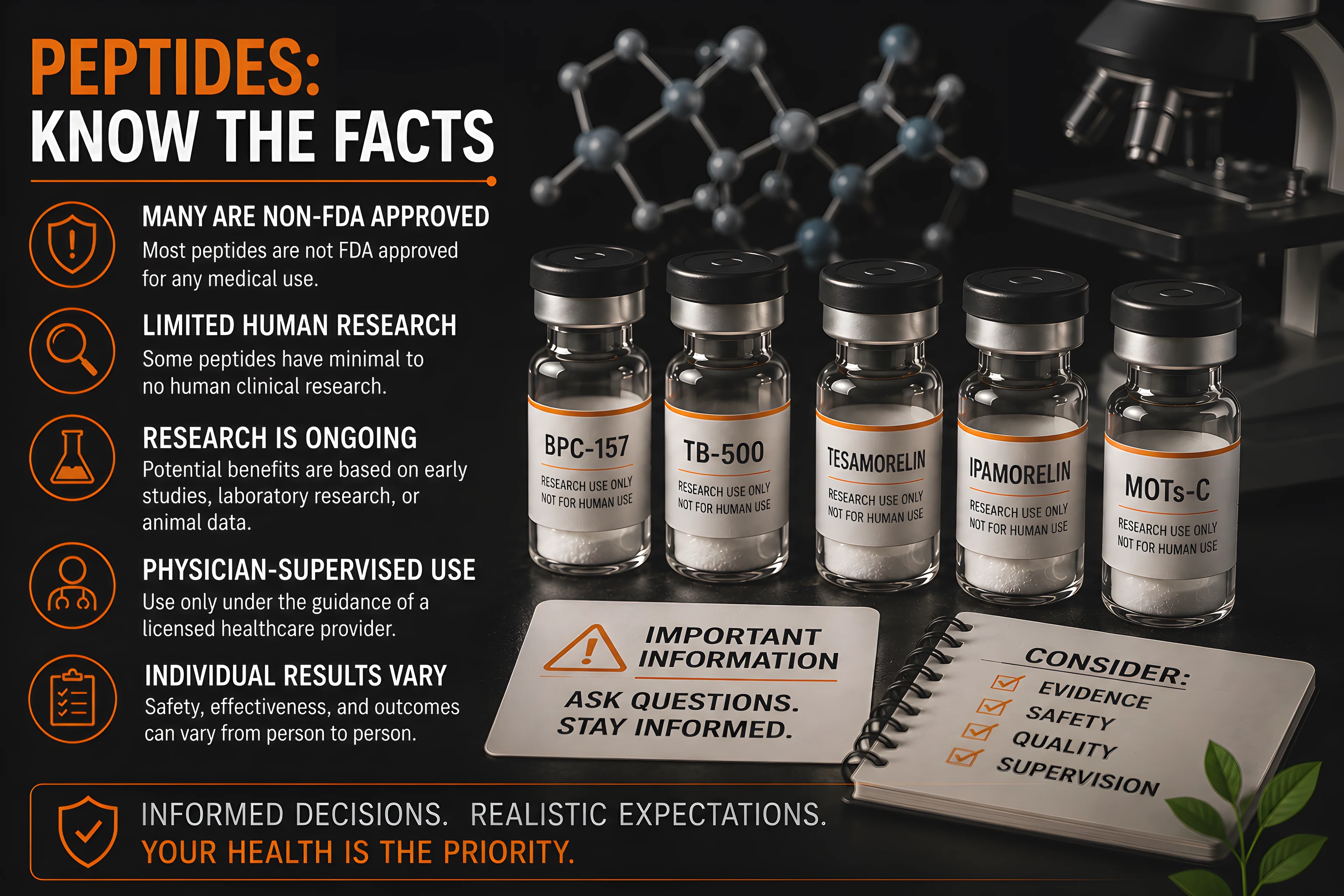
Many peptides used in peptide therapy have not been approved by the FDA for the indications in which they may be prescribed. Patients should consult with their healthcare provider to fully understand potential risks, benefits, and treatment options.
What Does “Anti-Aging” Mean at R2 Medical Clinic?
The term anti-aging can be misleading if it implies that medicine can stop the passage of time. It cannot.
Chronological aging is inevitable. But people of the same chronological age can have very different levels of metabolic health, cardiovascular fitness, muscle mass, bone health, mobility and overall function.
That is why our approach focuses less on trying to “reverse your age” and more on helping patients preserve health and function as they get older.
In practical terms, anti-aging medicine may involve identifying and addressing factors associated with declining health, including:
- Obesity and excess visceral fat
- Insulin resistance and metabolic disease
- Hypertension and abnormal cholesterol
- Loss of muscle mass and strength
- Declining cardiovascular fitness
- Poor sleep or sleep disorders
- Nutritional deficiencies
- Hormonal deficiencies when clinically appropriate
- Menopausal symptoms
- Sexual health concerns
- Declining mobility
- Bone loss and osteoporosis risk
- Smoking and other modifiable health risks
To learn more about “anti-aging”: What Does “Anti-Aging” Actually Mean? A Physician’s Look at Longevity, Biological Age & Healthspan
To learn more about epigenetics: What Is an Epigenetic Clock?
Why Are Peptides Studied?
Different peptides interact with different biological pathways. Depending on the specific compound, researchers have investigated peptides and related compounds for potential effects involving:
- Muscle and body composition — pathways involved in growth hormone signaling, lean mass and metabolism
- Recovery and tissue biology — mechanisms involved in inflammation, angiogenesis, cellular migration and tissue repair
- Sleep and recovery — pathways involved in sleep regulation and neuroendocrine signaling
- Metabolic health — glucose regulation, energy metabolism and body composition
- Cognitive and neurological function — signaling pathways involved in brain function and neurobiology
- Skin and connective tissue — collagen production, wound healing and tissue remodeling
- Immune function — pathways involved in innate and adaptive immune responses
- Sexual and reproductive health — hormonal and neurological pathways involved in reproductive and sexual function
- Biological processes associated with aging — including mitochondrial function, metabolic signaling, inflammation and cellular function
Research into these biological pathways does not mean that every peptide has been shown to produce these benefits in humans. The quality and quantity of evidence vary substantially by compound, and for some peptides the available evidence remains predominantly preclinical.
Likewise, studying a pathway associated with aging is not evidence that a peptide slows, stops or reverses human aging.
Where fat loss is the primary goal, peptides are most often used as one component of a broader physician-supervised medical weight loss program — alongside lab work, body composition analysis, and ongoing monitoring — rather than on their own.
Peptides & Related Compounds Table
Click on peptide name to view its dedicated page with mechanism, benefits, risks, FDA status, and supporting clinical evidence.
| Peptide | Primary Mechanism of Action (MOA) | FDA /Regulatory Status | Human Clinical Evidence |
|---|---|---|---|
| Tesamorelin | GHRH analog that stimulates pituitary GH release → ↑ IGF-1 | Yes — FDA-approved for reduction of excess abdominal fat in adults with HIV-associated lipodystrophy; not approved for general weight loss or anti-aging. | Extensive – Multiple Phase III randomized trials |
| Ipamorelin | Selective ghrelin (GHS-R1a) receptor agonist → stimulates endogenous GH release | No | Limited – Early human pharmacodynamic studies and small clinical trials |
| Thymosin Beta-4 (TB4) | Actin-binding peptide that promotes cell migration, angiogenesis, and tissue repair | No | Limited – Primarily ophthalmology (dry eye/corneal healing); most data are preclinical |
| Sermorelin | GHRH (1-29) analog that stimulates physiologic GH secretion | Historical FDA approval; no currently marketed FDA-approved product | Moderate – Historical clinical use and endocrine studies, primarily involving GH deficiency; limited evidence for contemporary adult wellness/anti-aging use |
| MK-677 (Ibutamoren) | Oral ghrelin receptor agonist that increases GH and IGF-1 secretion | No | Moderate – Multiple human trials demonstrate GH/IGF-1 effects, but clinical benefit for anti-aging, body composition, or wellness remains unestablished |
| BPC-157 | Proposed modulation of nitric oxide signaling, angiogenesis, fibroblast migration, and tissue repair | No | Very Limited – Predominantly animal and laboratory research; insufficient clinical evidence to establish efficacy or safety in humans |
| Thymosin Alpha-1 | Immunomodulator that enhances T-cell, dendritic cell, and innate immune function | Not FDA-approved (approved in several other countries) | Extensive – Substantial human clinical research across several disease states; strength of evidence and clinical applicability vary considerably by indication |
| GHK-Cu | Copper-binding tripeptide that stimulates collagen synthesis, tissue remodeling, and wound repair | No injectable FDA approval | Moderate – Human cosmetic/wound-healing studies; systemic use largely preclinical |
| MOTS-c | Mitochondrial-derived peptide that activates AMPK and improves metabolic signaling | No | Limited – Small human metabolic studies; active clinical trials |
| SS-31 (Elamipretide) | Binds mitochondrial cardiolipin, improving ATP production and mitochondrial efficiency | Yes — FDA accelerated approval for Barth syndrome in patients weighing ≥30 kg; other uses remain investigational/off-label | Extensive – Multiple Phase I–III trials |
| Kisspeptin | Activates KISS1 receptor → stimulates GnRH → LH/FSH release | No | Moderate – Human studies primarily in reproductive endocrinology and fertility; therapeutic applications outside these settings remain investigational |
| Gonadorelin | Synthetic GnRH that stimulates LH and FSH secretion | Historically FDA-approved for diagnostic and reproductive-endocrine indications; availability of currently marketed products varies | Extensive – Decades of endocrine and fertility research |
| Oxytocin | Oxytocin receptor agonist causing uterine contraction, milk letdown, and central neuromodulation | Yes — FDA-approved for specific obstetric indications; use for sexual function, bonding, or wellness is not an FDA-approved indication. | Extensive – Thousands of clinical studies |
| Epithalon (Epitalon) | Proposed activation of telomerase, antioxidant pathways, and melatonin regulation | No | Very Limited – Mostly Russian/Eastern European studies; substantial preclinical evidence |
| AOD-9604 | hGH fragment investigated for potential effects on lipolysis and lipid metabolism | No | Moderate – Evaluated in obesity trials, but development for obesity did not demonstrate sufficient efficacy for approval |
| PT-141 (Bremelanotide) | Melanocortin MC4R/MC3R agonist that increases central sexual desire and arousal | Yes — FDA-approved for acquired, generalized HSDD in premenopausal women; not FDA-approved for male sexual dysfunction. | Extensive – Phase III randomized trials |
| KPV | α-MSH-derived tripeptide proposed to modulate NF-κB signaling and inflammatory cytokine pathways | No | Minimal – Primarily laboratory and animal research; meaningful human clinical efficacy data are lacking |
| NAD+ | Essential metabolic coenzyme involved in ATP production, mitochondrial function, DNA repair, and sirtuin activation | No (IV NAD+ is not FDA-approved as a drug) | Limited for IV NAD+ – Extensive basic science exists regarding NAD biology, but clinical evidence for direct intravenous NAD+ therapy remains limited. Evidence involving oral NAD+ precursors should not be assumed to apply to IV NAD+. |
- Mechanism of Action
- GHRH analog that stimulates pituitary GH release → ↑ IGF-1
- FDA /Regulatory Status
- Yes — FDA-approved for reduction of excess abdominal fat in adults with HIV-associated lipodystrophy; not approved for general weight loss or anti-aging.
- Human Clinical Evidence
- Extensive – Multiple Phase III randomized trials
- Mechanism of Action
- Selective ghrelin (GHS-R1a) receptor agonist → stimulates endogenous GH release
- FDA /Regulatory Status
- No
- Human Clinical Evidence
- Limited – Early human pharmacodynamic studies and small clinical trials
- Mechanism of Action
- Actin-binding peptide that promotes cell migration, angiogenesis, and tissue repair
- FDA /Regulatory Status
- No
- Human Clinical Evidence
- Limited – Primarily ophthalmology (dry eye/corneal healing); most data are preclinical
- Mechanism of Action
- GHRH (1-29) analog that stimulates physiologic GH secretion
- FDA /Regulatory Status
- Historical FDA approval; no currently marketed FDA-approved product
- Human Clinical Evidence
- Moderate – Historical clinical use and endocrine studies, primarily involving GH deficiency; limited evidence for contemporary adult wellness/anti-aging use
- Mechanism of Action
- Oral ghrelin receptor agonist that increases GH and IGF-1 secretion
- FDA /Regulatory Status
- No
- Human Clinical Evidence
- Moderate – Multiple human trials demonstrate GH/IGF-1 effects, but clinical benefit for anti-aging, body composition, or wellness remains unestablished
- Mechanism of Action
- Proposed modulation of nitric oxide signaling, angiogenesis, fibroblast migration, and tissue repair
- FDA /Regulatory Status
- No
- Human Clinical Evidence
- Very Limited – Predominantly animal and laboratory research; insufficient clinical evidence to establish efficacy or safety in humans
- Mechanism of Action
- Immunomodulator that enhances T-cell, dendritic cell, and innate immune function
- FDA /Regulatory Status
- Not FDA-approved (approved in several other countries)
- Human Clinical Evidence
- Extensive – Substantial human clinical research across several disease states; strength of evidence and clinical applicability vary considerably by indication
- Mechanism of Action
- Copper-binding tripeptide that stimulates collagen synthesis, tissue remodeling, and wound repair
- FDA /Regulatory Status
- No injectable FDA approval
- Human Clinical Evidence
- Moderate – Human cosmetic/wound-healing studies; systemic use largely preclinical
- Mechanism of Action
- Mitochondrial-derived peptide that activates AMPK and improves metabolic signaling
- FDA /Regulatory Status
- No
- Human Clinical Evidence
- Limited – Small human metabolic studies; active clinical trials
- Mechanism of Action
- Binds mitochondrial cardiolipin, improving ATP production and mitochondrial efficiency
- FDA /Regulatory Status
- Yes — FDA accelerated approval for Barth syndrome in patients weighing ≥30 kg; other uses remain investigational/off-label
- Human Clinical Evidence
- Extensive – Multiple Phase I–III trials
- Mechanism of Action
- Activates KISS1 receptor → stimulates GnRH → LH/FSH release
- FDA /Regulatory Status
- No
- Human Clinical Evidence
- Moderate – Human studies primarily in reproductive endocrinology and fertility; therapeutic applications outside these settings remain investigational
- Mechanism of Action
- Synthetic GnRH that stimulates LH and FSH secretion
- FDA /Regulatory Status
- Historically FDA-approved for diagnostic and reproductive-endocrine indications; availability of currently marketed products varies
- Human Clinical Evidence
- Extensive – Decades of endocrine and fertility research
- Mechanism of Action
- Oxytocin receptor agonist causing uterine contraction, milk letdown, and central neuromodulation
- FDA /Regulatory Status
- Yes — FDA-approved for specific obstetric indications; use for sexual function, bonding, or wellness is not an FDA-approved indication.
- Human Clinical Evidence
- Extensive – Thousands of clinical studies
- Mechanism of Action
- Proposed activation of telomerase, antioxidant pathways, and melatonin regulation
- FDA /Regulatory Status
- No
- Human Clinical Evidence
- Very Limited – Mostly Russian/Eastern European studies; substantial preclinical evidence
- Mechanism of Action
- hGH fragment investigated for potential effects on lipolysis and lipid metabolism
- FDA /Regulatory Status
- No
- Human Clinical Evidence
- Moderate – Evaluated in obesity trials, but development for obesity did not demonstrate sufficient efficacy for approval
- Mechanism of Action
- Melanocortin MC4R/MC3R agonist that increases central sexual desire and arousal
- FDA /Regulatory Status
- Yes — FDA-approved for acquired, generalized HSDD in premenopausal women; not FDA-approved for male sexual dysfunction.
- Human Clinical Evidence
- Extensive – Phase III randomized trials
- Mechanism of Action
- α-MSH-derived tripeptide proposed to modulate NF-κB signaling and inflammatory cytokine pathways
- FDA /Regulatory Status
- No
- Human Clinical Evidence
- Minimal – Primarily laboratory and animal research; meaningful human clinical efficacy data are lacking
- Mechanism of Action
- Essential metabolic coenzyme involved in ATP production, mitochondrial function, DNA repair, and sirtuin activation
- FDA /Regulatory Status
- No (IV NAD+ is not FDA-approved as a drug)
- Human Clinical Evidence
- Limited for IV NAD+ – Extensive basic science exists regarding NAD biology, but clinical evidence for direct intravenous NAD+ therapy remains limited. Evidence involving oral NAD+ precursors should not be assumed to apply to IV NAD+.
Human Evidence Key
| Rating | Interpretation |
|---|---|
| Extensive | Multiple controlled human trials, but strength and applicability vary by indication. |
| Moderate | Several human studies, with unresolved efficacy or limited applicability. |
| Limited | Small studies or early-phase clinical research. |
| Very Limited | Sparse human data; evidence primarily preclinical. |
| Minimal | Little or no meaningful human clinical evidence. |
Evidence ratings describe the amount of human research available and do not indicate FDA approval, proven effectiveness, or evidence supporting any specific off-label use offered by R2 Medical Clinic.
Understanding FDA Approval and Peptide Research
Peptide therapies vary significantly in regulatory status and scientific evidence. Some peptide-based medications are FDA-approved for specific medical indications. Others are not FDA-approved, and some have limited or no high-quality human clinical research. FDA approval of a peptide for one indication does not mean it is approved for other uses.
When considering a therapy, we discuss what is known, what remains uncertain, potential risks, available alternatives, and the quality of evidence supporting its use.
How Peptide Therapy Works at R2 Medical
Peptide therapy at R2 Medical Clinic follows a structured, physician-guided process:
Step 1 — Comprehensive Assessment
Detailed health history, symptoms, goals, laboratory findings, and other relevant clinical information to determine whether peptide therapy is appropriate and, if so, which options may warrant consideration.
Step 2 — Individualized Treatment Planning
When therapy is clinically appropriate, your provider reviews the available options, quality of evidence, potential benefits, risks, alternatives, and limitations before developing an individualized treatment plan.
Step 3 — Ongoing Monitoring
Regular follow-up appointments and appropriate laboratory monitoring to evaluate response, assess tolerability and safety, and adjust treatment when clinically appropriate.

FDA-Approved vs Investigational Peptides: What's the Difference?
Not all peptide therapies have the same regulatory status or the same level of scientific evidence. Some peptide-based medications have been reviewed and approved by the FDA for specific medical conditions, while others remain investigational or have limited human clinical research. Understanding these differences is an important part of making an informed treatment decision.
FDA-Approved Peptide Medications
An FDA-approved medication has undergone FDA review of data regarding its safety, effectiveness, manufacturing, and quality for a specific indication, dose, formulation, and patient population. FDA approval does not mean a medication is risk-free, but it does mean the FDA has determined that its benefits outweigh its known and potential risks for the approved use.
Some peptide-based medications have FDA-approved medical indications. However, an FDA-approved peptide used for another purpose may be considered off-label use.
What Does “Off-Label” Mean?
Off-label prescribing occurs when an FDA-approved medication is prescribed for a condition, dose, route of administration, or patient population that is different from its FDA-approved labeling. Healthcare providers generally may prescribe approved medications off-label when they determine that doing so is medically appropriate for an individual patient.
Importantly, FDA approval of a peptide for one condition does not mean the FDA has determined that it is safe or effective for every other proposed use.
What Is an Investigational Peptide?
An investigational peptide is one that is still being studied and has not received FDA approval for routine marketing for the proposed use. The amount of scientific evidence can vary considerably. Some investigational compounds have undergone human clinical trials, while others may have only limited human data or predominantly laboratory and animal research.
Early or preclinical research can be scientifically interesting, but it should not be interpreted as proof that a therapy is safe or effective in humans.
What About Compounded Peptides?
Compounded medications are another distinct category. Compounded drugs are not FDA-approved, even when they contain an active ingredient that is also found in an FDA-approved medication. The FDA does not review compounded products for safety, effectiveness, or quality before they are marketed. Compounded medications can serve an important medical need for certain patients, but they should not be represented as equivalent to an FDA-approved product.
Why This Distinction Matters
At R2 Medical Clinic, we believe patients should understand what is known—and what remains uncertain—before considering peptide therapy. The FDA status, quality of human evidence, potential benefits, known and unknown risks, alternatives, and individual health considerations should all be part of the treatment discussion.
FDA-approved does not mean appropriate for everyone, and investigational does not mean proven effective. The specific peptide, intended use, available evidence, and individual patient all matter.
Schedule Your Free Consultation
References & Medical Resources
- U.S. Food and Drug Administration. Pharmacy Compounding Advisory Committee Meeting — July 23–24, 2026. FDA considered BPC-157 (free base/acetate), KPV (free base/acetate), TB-500 (free base/acetate), and MOTS-c (free base/acetate) for potential inclusion on the Section 503A Bulks List.
FDA — July 2026 Pharmacy Compounding Advisory Committee - U.S. Food and Drug Administration. Bulk Drug Substances Nominated for Use in Compounding Under Section 503A. Updated April 22, 2026. FDA’s official listing and regulatory-status document for bulk substances nominated for use in 503A compounding. This is useful for explaining that the regulatory status of individual substances can change as nominations are evaluated, withdrawn, or considered by PCAC.
FDA — 503A Bulk Drug Substances - U.S. Food and Drug Administration. Certain Bulk Drug Substances for Use in Compounding That May Present Significant Safety Risks. FDA provides safety assessments for numerous substances relevant to peptide medicine, including ibutamoren, ipamorelin, kisspeptin-10 and others. The page also contains historical information regarding substances whose nominations have subsequently been withdrawn, including BPC-157, GHK-Cu, KPV, MOTS-c and AOD-9604.
FDA — Bulk Drug Substance Safety Information - U.S. Food and Drug Administration. Understanding the Risks of Compounded Drugs. FDA explains that compounded drugs are not FDA-approved and therefore do not undergo FDA premarket review for safety, effectiveness, or quality.
FDA — Understanding the Risks of Compounded Drugs - Falutz J, Potvin D, Mamputu JC, et al. Effects of tesamorelin, a growth hormone-releasing factor, in HIV-infected patients with abdominal fat accumulation: a randomized placebo-controlled trial with a safety extension. J Acquir Immune Defic Syndr. 2010;53(3):311–322. doi:10.1097/QAI.0b013e3181cbdaff.
PubMed — Tesamorelin Randomized Controlled Trial - Stanley TL, Feldpausch MN, Oh J, et al. Effect of tesamorelin on visceral fat and liver fat in HIV-infected patients with abdominal fat accumulation: a randomized clinical trial. JAMA. 2014;312(4):380–389. doi:10.1001/jama.2014.8334.
PubMed — Tesamorelin JAMA Trial - Stanley TL, Falutz J, Marsolais C, et al. Reduction in visceral adiposity is associated with an improved metabolic profile in HIV-infected patients receiving tesamorelin. Clinical Infectious Diseases. 2012;54(11):1642–1651. doi:10.1093/cid/cis251.
PubMed — Tesamorelin and Visceral Adiposity - Lee E, Burgess K. Safety of Intravenous Infusion of BPC157 in Humans: A Pilot Study. Altern Ther Health Med. 2025;31(5):20–24. This small pilot study involved only two participants, so it should be cited as evidence that some human research exists—not as evidence establishing clinical efficacy or overall safety.
PubMed — BPC-157 Human Pilot Study - BPC-157 as an Investigational Peptide Therapeutic: Biopharmaceutical Challenges, Formulation Strategies, and Translational Development Barriers. 2026 review of the BPC-157 literature and development landscape. The authors characterize BPC-157 as investigational and note the substantial gap between its preclinical literature and established clinical evidence.
PubMed — 2026 BPC-157 Review
Medically reviewed by Erik Natkin, DO — Founder, Medical Director, & Physician, R2 Medical Clinic. Content last reviewed September 2026.