Your Testosterone Is Dropping, and It's Not Just Because You're Getting Older
Testosterone in American men has fallen ~25% in recent decades — from ultra-processed foods, toxins, and lifestyle, not aging alone. R2 Medical explains why.
R2 Medical Clinic • 9 min read

TL;DR
Testosterone levels in American men have dropped roughly 25% in recent decades because of ultra-processed foods, environmental toxins, and modern lifestyle factors. This decline affects energy, muscle mass, bone density, cognitive function, and long-term health. Testing, lifestyle changes, and medical interventions like Testosterone Replacement Therapy offer evidence-based solutions for men experiencing symptoms of low testosterone.
Testosterone decline affects your entire body:
- Men ages 15-40 have experienced a 25% drop in testosterone over recent decades
- Ultra-processed foods, plastics, pesticides, and lifestyle factors drive this decline
- Low testosterone increases risks for obesity, diabetes, heart disease, and early mortality
- Lifestyle modifications and medical treatments like TRT restore hormone balance
- Comprehensive hormone testing provides the foundation for personalized treatment
Why You Feel Different (Even Before the Labs Confirm It)
You feel the change before lab results prove anything.
Energy that used to carry you through back-to-back meetings now fades by 2pm. Workouts feel harder but deliver less. Your libido isn't what it was five years ago. You tell yourself it's aging, stress, poor sleep.
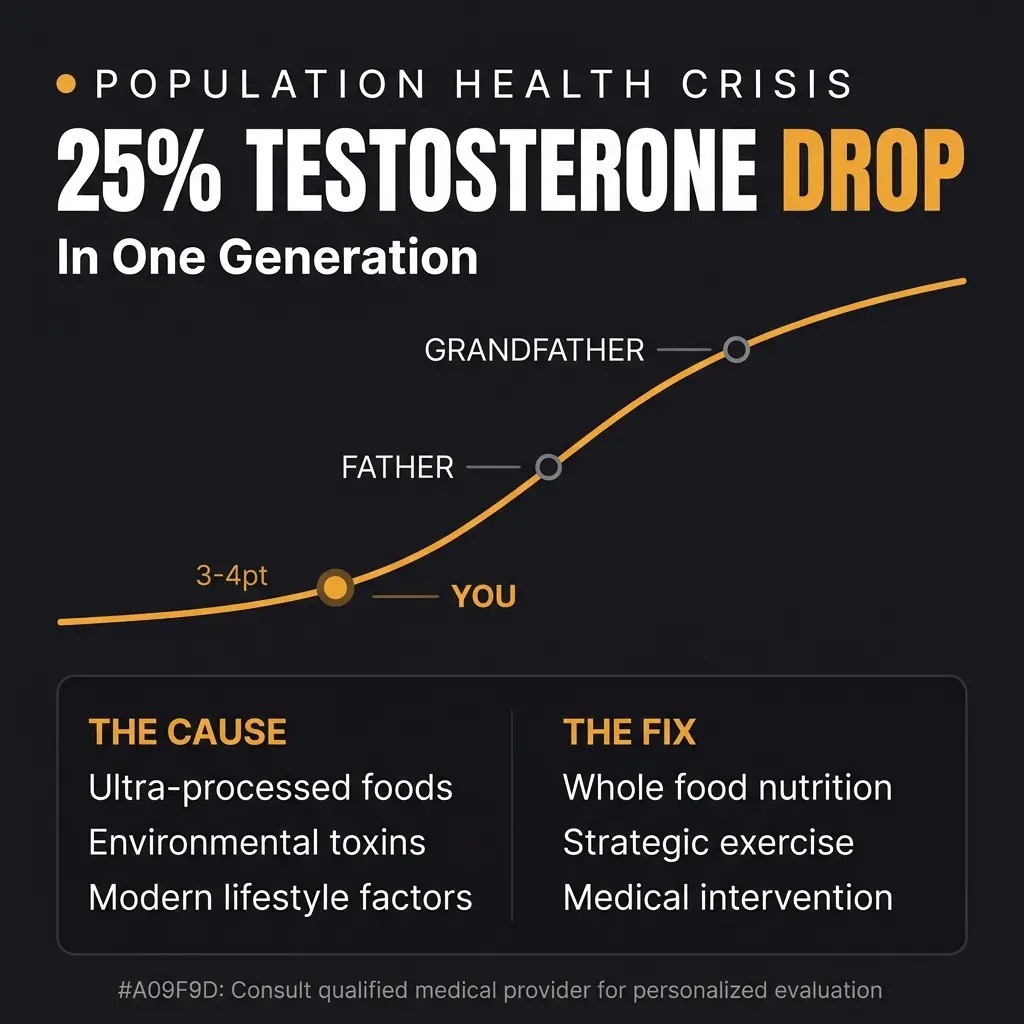
Here's what most men don't know: your testosterone levels are lower than your father's were at your age. Your father's levels were lower than your grandfather's.
This isn't aging. Something bigger is happening.
Key Point: Symptoms of low testosterone appear gradually and feel like normal aging, but they often signal a measurable, treatable hormone decline.
What Is Causing This Widespread Testosterone Decline?
Testosterone levels have declined by nearly 25% among young men ages 15-40 over recent decades. One in five young men experiences clinically low testosterone, a condition that used to appear primarily in men over 60.
A man in his sixties measured in 2004 had testosterone levels around 17% lower than a man of the same age measured in 1987. This pattern holds across age groups, geographies, and body types.
Gen Z and millennial men have lower testosterone levels compared to their predecessors at the same age. This isn't a statistical blip. It's a population-wide shift pointing to environmental and lifestyle factors we need to address.
Key Point: Testosterone decline affects all age groups and demographics, indicating systemic environmental and lifestyle causes rather than individual genetics.
What Causes Low Testosterone in Modern Men?
The simple answer is obesity. The complete answer is more complex.
Excess body fat, particularly visceral fat around your midsection, converts testosterone into estrogen and disrupts hormone production. But the decline persists even after researchers account for changes in body mass index.
The causes are everywhere.
How Ultra-Processed Foods Lower Testosterone
A 2025 study published in Nature Reviews Urology showed that consumption of ultra-processed foods reduces sperm quality, lowers follicle-stimulating hormone, and decreases circulating testosterone levels.
"We were shocked by how many body functions were disrupted by ultra-processed foods, even in healthy young men," researchers from the University of Copenhagen reported.
Study participants gained around one kilogram of extra fat mass on average. Levels of a plastics-related phthalate chemical called cxMINP also rose during the trial period.
The double hit: the food disrupts your hormones, and the packaging adds another layer of endocrine interference.
Key Point: Ultra-processed foods harm testosterone production directly through nutritional deficiency and indirectly through chemical exposure from packaging.
How Environmental Toxins Disrupt Hormones
You're exposed to hormone-disrupting chemicals daily.
BPA and phthalates in plastics mimic estrogen and disrupt Leydig cell function in your testes. These cells produce testosterone. Men exposed to higher levels show testosterone reductions of up to 20%.
Pesticides in food and occupational exposure link to lower testosterone levels, with atrazine showing particular harm. A 2014 study in Environmental Health Perspectives found that men with high urinary phthalate concentrations had lower testosterone levels.
These chemicals accumulate over time. They're in your water bottles, food containers, cleaning products, and personal care items.
Key Point: Daily exposure to plastics, pesticides, and industrial chemicals creates cumulative hormone disruption that lowers testosterone production over time.
How Lifestyle Factors Lower Testosterone
Modern life doesn't support healthy testosterone production.
Sedentary work, chronic stress, poor sleep, and lack of sunlight all contribute to declining hormone levels. Childhood environment, rather than genetics or ethnicity, is the major factor influencing men's testosterone levels as adults.
You don't out-supplement a lifestyle that's actively lowering your testosterone.
Key Point: Environmental factors and daily habits during childhood and adulthood shape testosterone levels more than genetics.
What Is Andropause and How Does It Differ From Menopause?
Women experience a sudden hormone drop during menopause. Men face a gradual decline starting in their mid-30s.
A man's testosterone level begins to drop around age 35 and continues to fall at an average rate of 1.6% per year. By age 75, men have lost about 30% of their testosterone.
About 30% of men between ages 40 and 79 have clinically low testosterone levels.
This slow decline means symptoms creep up on you. You adapt to feeling less energetic, less motivated, less interested in sex. You assume it's normal aging.
Sometimes it is normal aging. Sometimes it's a treatable medical condition. Our guide to TRT for aging management breaks down the difference.
Key Point: Andropause involves a gradual 1.6% annual testosterone decline starting at age 35, making symptoms easy to dismiss as normal aging when they're often treatable.
How Does Low Testosterone Affect Your Health?
Low testosterone affects more than libido and erectile function, though those are common concerns.
Reduced testosterone levels are associated with:
- Decreased muscle mass and strength
- Reduced aerobic capacity
- Decreased bone-mineral density and increased risk of hip fracture
- Impaired spatial cognition
- Increased risk of visceral obesity
- Impaired glucose tolerance and higher risk of type 2 diabetes
- Increased risk of coronary artery disease
- Higher all-cause mortality
Lower testosterone values link to increased comorbidities and higher risk for death from any cause.
This isn't about vanity. It's about comprehensive health.
Key Point: Low testosterone increases risk for muscle loss, bone fractures, diabetes, heart disease, and early mortality, making it a serious health concern beyond sexual function.
What Does Declining Sperm Quality Tell Us?
Testosterone decline doesn't exist in isolation.
Sperm count has dropped 50-60% in the past 40 years, and sperm quality has declined. Grip strength, a reliable marker of overall health, has declined by 20% over 30 years.
These markers point to the same conclusion: modern life is disrupting male reproductive and metabolic health.
Key Point: Parallel declines in sperm quality, testosterone, and grip strength confirm that environmental factors are systematically affecting male health.
What Steps Can You Take to Protect Your Testosterone Levels?
You don't control every environmental exposure or reverse decades of societal change. You do take specific actions to protect and optimize your testosterone levels.
How to Optimize Testosterone Through Lifestyle Changes
Reduce ultra-processed food consumption. Focus on whole foods, lean proteins, healthy fats, and vegetables. Limit packaged foods in plastic containers.
Minimize exposure to endocrine disruptors. Use glass or stainless steel for food storage. Choose natural cleaning and personal care products when possible. Filter your drinking water.
Prioritize sleep. Aim for 7-9 hours of quality sleep per night. Most testosterone production happens during sleep.
Manage stress. Chronic cortisol elevation suppresses testosterone production. Find stress management techniques that work for you.
Exercise strategically. Resistance training and high-intensity interval training support healthy testosterone levels. Chronic endurance exercise without adequate recovery lowers testosterone.
Maintain a healthy body composition. Reduce excess body fat, particularly around your midsection.
For a deeper dive on the non-medical levers, see our practical guide to natural hormone therapy for men.
Key Point: Six evidence-based lifestyle modifications protect testosterone: whole foods, toxin avoidance, quality sleep, stress management, strategic exercise, and healthy body composition.
Why Hormone Testing Matters
You don't manage what you don't measure.
If you're experiencing persistent fatigue, reduced libido, difficulty building muscle, mood changes, or cognitive fog, get comprehensive hormone testing.
Total testosterone, free testosterone, estradiol, and other hormone markers provide a complete picture of your endocrine health.
Key Point: Comprehensive hormone testing identifies specific imbalances and establishes a baseline for monitoring treatment effectiveness.
When Is Testosterone Replacement Therapy Appropriate?
For men with clinically low testosterone levels and symptoms that impact quality of life, Testosterone Replacement Therapy (TRT) is an appropriate medical intervention. New to it? Start with our beginner's guide to TRT.
TRT is a physician-supervised treatment restoring testosterone to normal physiological levels. It's not a performance enhancer or anti-aging solution. It's a medical treatment for a medical condition.
At R2 Medical Clinic, we take a comprehensive approach to hormone optimization. We evaluate your complete health picture, address underlying factors, monitor your response to treatment, and adjust protocols based on your needs.
Our medical team develops personalized treatment plans that include TRT, peptide therapy, nutritional optimization, and lifestyle modifications. All designed to help you feel strong, clear, and in control.
Key Point: TRT is a physician-supervised medical treatment for clinically low testosterone that restores hormone balance when lifestyle modifications aren't sufficient.
Frequently Asked Questions About Testosterone Decline
What are the first signs of low testosterone?
At what age does testosterone start declining?
How do ultra-processed foods affect testosterone?
What testosterone level is considered clinically low?
Does testosterone replacement therapy have side effects?
What lifestyle changes boost testosterone naturally?
How long does it take to see results from testosterone therapy?
Is testosterone decline reversible?
Key Takeaways
- Testosterone levels in American men have declined 25% over recent decades due to ultra-processed foods, environmental toxins, and lifestyle factors, not aging alone
- Low testosterone affects energy, muscle mass, bone density, cognitive function, metabolic health, and increases risks for diabetes, heart disease, and early mortality
- One in five young men now experiences clinically low testosterone, a condition that historically appeared primarily in men over 60
- Evidence-based lifestyle modifications protect testosterone: whole food nutrition, toxin avoidance, quality sleep, stress management, resistance training, and healthy body composition
- Comprehensive hormone testing (total testosterone, free testosterone, estradiol) provides the foundation for personalized treatment decisions
- Testosterone Replacement Therapy is a physician-supervised medical treatment that restores hormone balance for men with clinically low levels and quality-of-life symptoms
- R2 Medical Clinic offers comprehensive hormone evaluation and personalized treatment plans combining TRT, peptide therapy, nutritional optimization, and lifestyle support
Ready to Optimize Your Hormone Health?
R2 Medical Clinic offers comprehensive hormone evaluation and personalized treatment plans for men experiencing symptoms of low testosterone.
Our medical team uses evidence-based protocols to help you optimize your health and vitality. We serve patients across Colorado and Utah with convenient locations and consistent, high-quality care.
Schedule a consultation today to discuss your symptoms, get comprehensive testing, and explore whether TRT or other hormone optimization strategies are right for you.
Your best health is ahead of you.