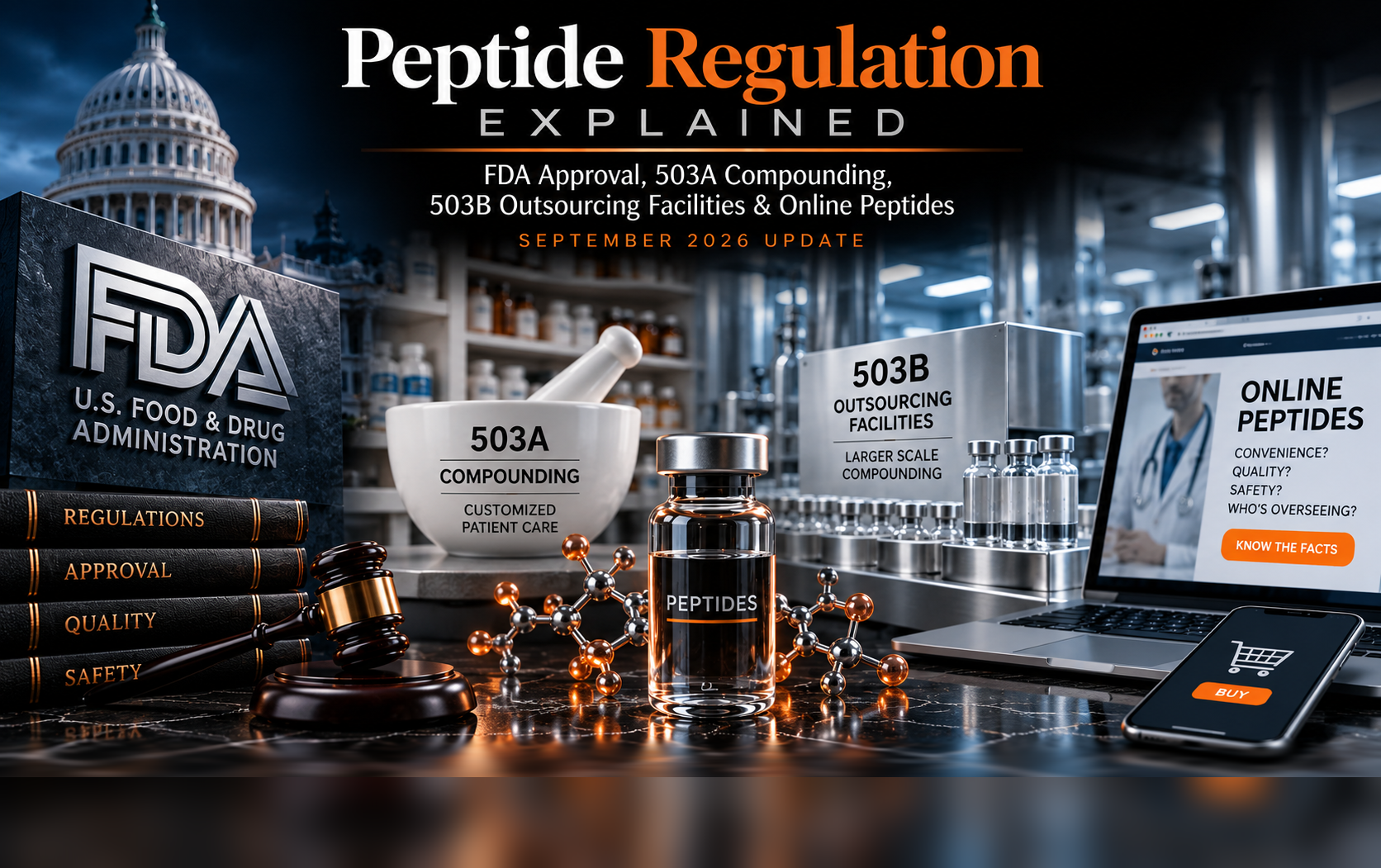
Peptide Regulation Explained: FDA Approval, 503A Compounding, 503B Outsourcing Facilities & Online Peptides. September 2026 Update.
FDA-approved vs. compounded peptides, 503A vs. 503B, bulk substance rules, and why “research use only” peptides aren't the same as a prescription medication.
Erik Natkin, DO • 22 min read
Medically reviewed by Erik Natkin, DO — Founder, R2 Medical Clinic, Denver, Colorado
Last medically reviewed: September 2026
Peptide therapy has become increasingly popular.
Unfortunately, the regulatory environment surrounding peptides has also become increasingly confusing.
Patients may encounter peptides through an FDA-approved medication, a traditional compounding pharmacy, an outsourcing facility, a telemedicine clinic, or a website selling products labeled “research use only.”
These products are not necessarily regulated in the same way.
Even more confusing, the regulatory status of a particular peptide may change as the U.S. Food and Drug Administration evaluates new information.
Understanding peptide regulation therefore requires answering several separate questions:
- Is the peptide part of an FDA-approved drug?
- Is it being compounded?
- Is it being compounded by a 503A pharmacy or 503B outsourcing facility?
- Is the active ingredient permitted for use in compounding?
- Is the product being prescribed for an individual patient?
- Is it being sold as a medication or as a “research” product?
- Is an appropriately licensed healthcare professional supervising treatment?
The fact that something is called a peptide tells us very little about its regulatory status.
First: What Is a Peptide?
Peptides are short chains of amino acids.
The human body naturally produces many peptides that function as signaling molecules involved in processes such as:
- Hormonal signaling
- Appetite and satiety
- Metabolism
- Growth
- Reproduction
- Gastrointestinal function
- Immune signaling
- Numerous other physiologic processes
Peptide-based medications are not inherently experimental. Several FDA-approved medications are peptides or peptide-related drugs.

At the same time, many peptides promoted online have never received FDA approval for the uses for which they are being marketed.
This creates one of the most important distinctions in peptide medicine:
“Peptide” is a chemical or biological description—not a regulatory category.
Are Peptides Legal?
The short answer is: some are, under specific circumstances—but “peptides” cannot accurately be described as simply legal or illegal.
Peptides are a broad category of molecules, not a single type of medication. Their regulatory status depends on the specific peptide, how it is manufactured, how it is marketed, where it comes from and how it is being used.
Some peptide medications are FDA-approved drugs. These products have gone through FDA’s drug-approval process for specific indications, formulations and routes of administration.
Other peptide medications may be compounded legally under federal and state law when the applicable requirements are satisfied. Compounded medications, however, are not FDA-approved. FDA does not review compounded drugs for safety, effectiveness or quality before they are marketed in the same manner as FDA-approved drugs.
For medications compounded under Section 503A, federal law generally requires compounding for an identified individual patient pursuant to a valid prescription and places specific restrictions on the bulk drug substances that may be used. A physician’s decision to prescribe a peptide does not, by itself, make that peptide eligible for compounding.
503B outsourcing facilities operate under a different federal framework. They register with FDA and are subject to additional federal requirements, including current good manufacturing practice requirements. Federal law also restricts which bulk drug substances these facilities may use.
Finally, peptides sold directly online as “research use only,” “laboratory use only” or “not for human consumption” should not be confused with prescription medications dispensed through a legitimate pharmacy. FDA has taken enforcement action against companies selling purported research peptides when the products’ marketing demonstrated that they were actually intended for human use. In 2026, for example, FDA warning letters addressed products labeled “research use only” or “not for human consumption” that the agency determined were being marketed as unapproved new drugs for human use.
Therefore, asking “Are peptides legal?” is only the beginning of the discussion.
The more useful questions are:
- Which peptide are we talking about?
- Is there an FDA-approved version?
- If it is compounded, is that particular substance eligible for compounding under the applicable federal requirements?
- Is it being prepared through an appropriate 503A pharmacy or 503B outsourcing facility?
- Is it being prescribed and dispensed through a legitimate medical and pharmacy pathway?
- What evidence supports its use for this particular patient and treatment goal?
A peptide being discussed online, available for purchase, prescribed by a healthcare professional or even prepared by a pharmacy does not necessarily answer all of these questions.
The regulatory status of each peptide must be evaluated individually and based on current law and FDA policy.
Category 1: FDA-Approved Peptide Medications
The clearest regulatory pathway is an FDA-approved drug.
Before approving a new drug, FDA evaluates evidence regarding its safety, effectiveness, manufacturing and quality for specific indications.
FDA approval also establishes requirements involving manufacturing, labeling and ongoing regulatory oversight.
This does not mean an FDA-approved medication is risk-free. It means the medication has gone through the FDA drug-approval process.
That is fundamentally different from a compounded medication.
Category 2: Compounded Peptide Medications
Compounding allows a pharmacist or physician, under specific circumstances, to prepare a medication for a patient’s medical needs.
Compounding can play an important role when an FDA-approved medication does not appropriately meet a patient’s needs.
But there is an essential distinction:
Compounded drugs are not FDA-approved drugs.
FDA does not individually evaluate compounded medications for safety, effectiveness and quality before they are dispensed in the same manner that it evaluates FDA-approved medications.
This remains true even when the medication is legitimately prescribed and prepared by a licensed compounding pharmacy.
Two major sections of federal law govern much of human drug compounding: Section 503A and Section 503B of the Federal Food, Drug, and Cosmetic Act.
They are not interchangeable.
What Is a 503A Compounding Pharmacy?
503A represents what most patients traditionally think of as a compounding pharmacy.
In general, medication is compounded for an identified individual patient pursuant to a valid prescription.
503A compounding may be performed by a licensed pharmacist in a state-licensed pharmacy or federal facility, or by a licensed physician when the applicable statutory requirements are satisfied.
State boards of pharmacy generally have primary responsibility for day-to-day oversight of state-licensed pharmacies that are not registered as outsourcing facilities. FDA still has regulatory and enforcement authority and may conduct inspections.
This means describing a 503A pharmacy simply as an “FDA-approved pharmacy” would be inaccurate.
A better description is: a state-licensed pharmacy operating within a federal and state regulatory framework for pharmacy compounding.
What Is a 503B Outsourcing Facility?
503B created a different category known as an outsourcing facility.
A 503B facility registers with FDA and is subject to a different regulatory framework.
Unlike traditional 503A compounding, a 503B outsourcing facility can compound certain medications without first receiving prescriptions for individually identified patients.
503B outsourcing facilities are also subject to FDA current Good Manufacturing Practice requirements and FDA inspection according to a risk-based schedule. This makes 503B different from 503A.
But there is another important point: 503B does not mean FDA-approved.
A compounded medication produced by a 503B outsourcing facility is still not the same thing as an FDA-approved drug.
503A vs. 503B: A Simple Way to Think About It
Although the complete regulations are considerably more complicated, patients can think about the distinction this way:
Four Pathways — Not Equivalent
 |
 |
 |
 |
|
|---|---|---|---|---|
| Question | FDA-approved drug | 503A compounded Traditional compounding pharmacy |
503B compounded Outsourcing facility |
Online “research peptide” |
| Is it FDA-approved? | Yes — reviewed and approved for specific indications. | No. Compounded drugs are not FDA-approved drugs. | No. 503B does not mean FDA-approved. | No. Not FDA-approved. |
| Who is it prepared for? | Any patient the approved labeling covers. | An identified individual patient, pursuant to a valid prescription. | Can compound certain medications without first receiving prescriptions for individually identified patients. | May be sold outside the traditional prescription and pharmacy system. |
| Who oversees it? | FDA — approval, manufacturing, labeling and ongoing oversight. | State boards of pharmacy day-to-day; FDA retains authority and may inspect. | Registers with FDA; FDA inspection on a risk-based schedule. | May fall outside the legitimate pharmacy dispensing pathway. |
| Manufacturing standard | FDA-regulated manufacturing and labeling requirements. | Traditional pharmacy-compounding framework, under state and federal requirements. | FDA current Good Manufacturing Practice (cGMP) requirements. | Significant variability in quality, purity and labeling. |
| How is it labeled? | FDA-approved labeling for the approved use. | Patient-specific prescription label. | Prepared in larger batches for healthcare settings. | Often “research use only” or “not for human consumption.” Increased risk to patient safety |
- FDA-approved drug: FDA has reviewed and approved the drug for specific indications and regulates its manufacturing and labeling.
- 503A compounded medication: Generally compounded for an identified individual patient pursuant to a prescription through a traditional pharmacy-compounding framework.
- 503B compounded medication: Produced by an FDA-registered outsourcing facility operating under additional federal manufacturing requirements.
- Online “research peptide”: May be sold outside the traditional prescription and pharmacy system and may explicitly state that it is “not for human consumption.”
These categories should not be treated as equivalent simply because the vial contains—or claims to contain—the same peptide.
Can a 503A Pharmacy Compound Any Peptide a Physician Prescribes?
No.
This is one of the most misunderstood areas of peptide therapy. A physician writing a prescription does not automatically make a peptide eligible for legal compounding.
Federal law places restrictions on which bulk drug substances may be used in 503A compounding.
In general, a bulk substance used for 503A compounding must satisfy an applicable USP or National Formulary monograph when one exists, be a component of an FDA-approved drug when the applicable conditions are met, or appear on FDA’s 503A Bulks List.
There are additional requirements as well. For example, the bulk substance must be accompanied by a valid certificate of analysis and manufactured by an establishment registered with FDA as required under federal law.
This is an important distinction between legitimate pharmaceutical compounding and simply purchasing peptide powder from an internet supplier.
Then Why Are Some Other Peptides Still Being Compounded?
This is where the regulatory environment becomes more complicated.
FDA has been evaluating substances that have been nominated for inclusion on the 503A Bulks List. During this process, FDA established an interim enforcement policy for certain nominated substances.
Historically, FDA divided nominated substances into three categories.
Category 1
These substances were nominated with sufficient information for FDA evaluation and did not appear on another list. Under FDA’s interim policy, the agency generally stated that it did not intend to take enforcement action against 503A compounders solely for using certain Category 1 substances while FDA evaluated them, provided the other conditions of the policy were satisfied.
Category 1 did not mean FDA-approved. It also did not necessarily mean that FDA had concluded the substance was safe or effective. It represented an interim regulatory position while FDA evaluated the substance.
Category 2
Category 2 included substances for which FDA identified potential significant safety risks. These substances did not receive the same interim enforcement approach afforded to Category 1 substances.
Category 3
Category 3 generally involved substances that had been nominated without sufficient supporting information for FDA to evaluate them. They likewise did not receive the Category 1 interim enforcement approach.
An Important 2025–2026 Change
Peptide regulation continues to evolve. FDA revised its interim policy in January 2025.
Under the revised policy, FDA stated that it does not intend to place substances newly nominated on or after January 7, 2025 into Categories 1, 2 or 3. Existing Category 1 substances may continue under the interim policy while FDA evaluates them, unless FDA removes them or otherwise changes their status.
Newer nominations instead proceed through FDA’s statutory evaluation process for possible inclusion on the 503A Bulks List.
This is one reason older internet articles and social-media posts describing a peptide as “Category 1” or “Category 2” may no longer accurately describe its current regulatory status.
2026 Has Already Brought Important Changes
Several peptides commonly discussed in peptide medicine have undergone regulatory changes or further FDA review.
For example, FDA’s April 2026 update removed several substances from previous categories after their nominations were withdrawn. These included substances associated with:
Removal from Category 2, however, should not automatically be interpreted as FDA determining that a substance is safe, effective or approved.
In several instances, FDA indicated that the agency intended to continue evaluating related substances through the Pharmacy Compounding Advisory Committee.
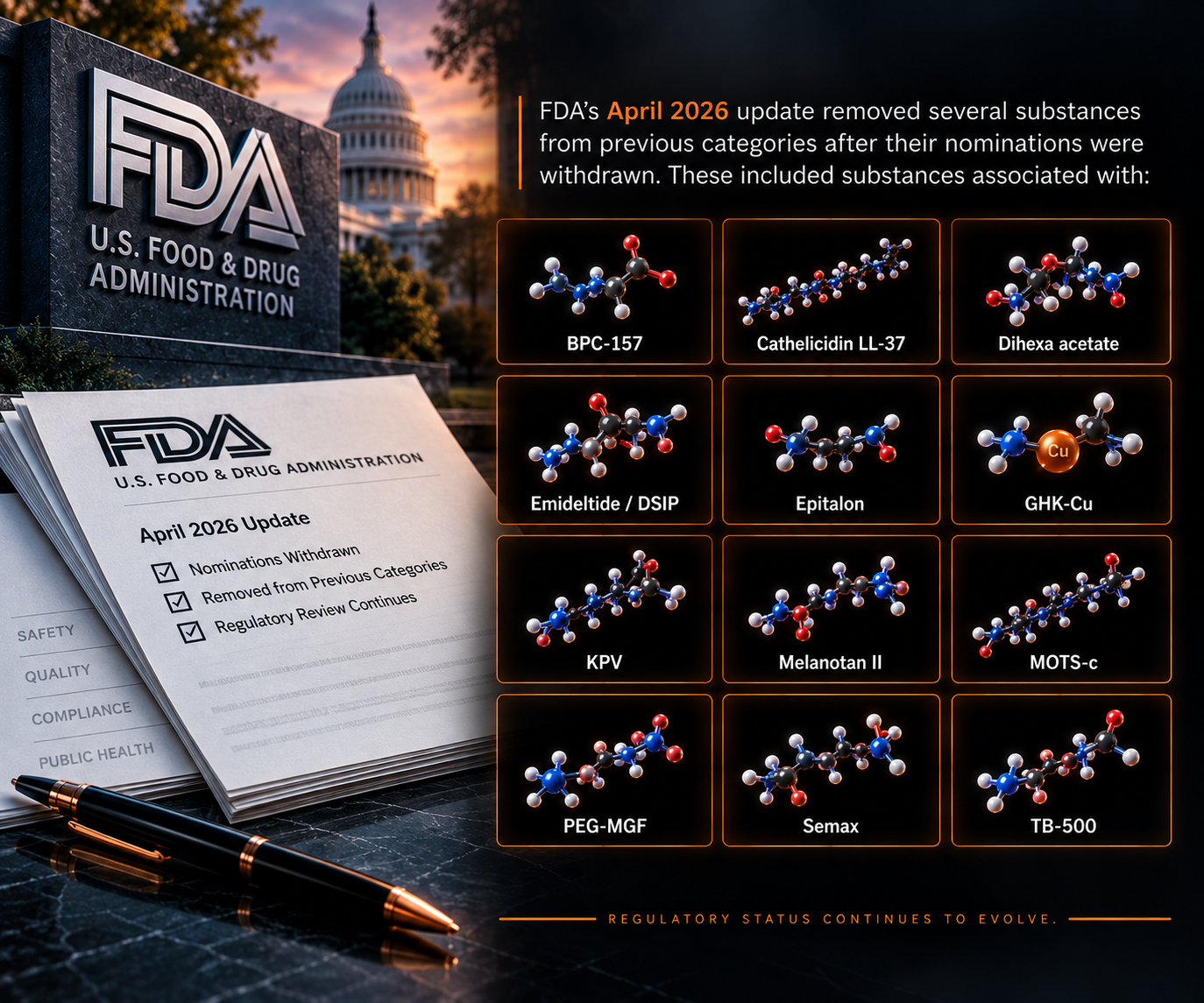
- BPC-157
- Cathelicidin LL-37
- Dihexa acetate
- Emideltide/DSIP
- Epitalon
- GHK-Cu
- KPV
- Melanotan II
- MOTS-c
- PEG-MGF
- Semax
- TB-500
That distinction matters. “No longer Category 2” does not mean “FDA-approved.”
FDA’s 2026 Review of Popular Peptides
In July 2026, FDA’s Pharmacy Compounding Advisory Committee considered several peptide-related bulk substances for potential inclusion on the 503A Bulks List. Among the substances reviewed were forms related to:
- BPC-157
- KPV
- TB-500
- MOTS-c
- Emideltide/DSIP
- Semax
- Epitalon
The uses considered by FDA varied by substance and included areas such as wound healing, inflammatory conditions, obesity, osteoporosis, insomnia and other proposed indications.
The important point for patients is not simply whether a particular peptide appeared before an FDA committee.
It is that FDA is actively evaluating whether particular bulk substances should be eligible for 503A compounding.
Being discussed by FDA is not the same as being FDA-approved. Being nominated for the 503A Bulks List is not the same as appearing on the final list. And appearing under an interim enforcement policy is not the same as FDA concluding that a treatment is safe and effective.
What Does “Significant Safety Risk” Mean?
FDA has identified potential safety concerns with several substances proposed for compounding.
Peptides can present unique manufacturing and characterization challenges. Depending upon the substance, FDA has raised concerns involving:
- Peptide-related impurities
- Aggregation
- Immunogenicity
- Difficulty characterizing the active pharmaceutical ingredient
- Limited human safety data
- Serious adverse events associated with particular substances or routes of administration
Importantly, the amount of evidence differs from peptide to peptide.
FDA’s identification of a potential risk does not necessarily establish that a particular adverse event was caused by the peptide.
But limited evidence is itself relevant when deciding whether a substance should be administered to patients.
Why Immunogenicity Matters With Peptides
One concern that appears repeatedly in FDA’s discussion of compounded peptides is immunogenicity.
The immune system can recognize certain proteins, peptides, aggregates or impurities as foreign. That can potentially trigger an immune response.
The manufacturing and purification of peptides can also be complicated, and peptide-related impurities may be difficult to characterize completely.
This is one reason pharmaceutical quality matters. A peptide should not be evaluated only by asking:
“Is the molecule supposed to work?”
We also need to ask:
“What exactly is in the finished product?”
What About BPC-157?
BPC-157 illustrates why patients and clinicians should be careful with simplified statements about peptide regulation.
BPC-157 has been widely promoted online for injury recovery and tissue healing.
It previously appeared in FDA’s Category 2 materials following identification of potential safety concerns and limited safety information. Its earlier nomination was subsequently withdrawn, and FDA removed it from Category 2 in its April 2026 update.
FDA then considered BPC-157-related bulk substances—BPC-157 free base and BPC-157 acetate—during the July 2026 Pharmacy Compounding Advisory Committee process.
None of those facts mean BPC-157 has become an FDA-approved drug. They illustrate a broader point:
Regulatory status must be checked currently and for the specific substance and formulation being considered.
“My Pharmacy Compounds It” Does Not Answer Every Regulatory Question
Patients sometimes assume that if a pharmacy is willing to prepare a peptide, the peptide itself must have been approved by FDA. That is not necessarily true.
There are several separate questions:
- Is the pharmacy appropriately licensed?
- Is the substance eligible for compounding under current federal law and FDA policy?
- Is the medication being compounded under 503A or 503B?
- Is the particular use supported by adequate clinical evidence?
- Is the treatment medically appropriate for this particular patient?
These questions should not be collapsed into one.
What About Peptides Sold Online as “Research Use Only”?
This is another regulatory category entirely.
Websites frequently sell peptide products labeled:
- “Research use only.”
- “For laboratory use only.”
- “Not for human consumption.”
Patients may nevertheless encounter social-media discussions, dosing instructions or other information suggesting that people are injecting these products.
A “research” label does not create a loophole allowing a company to market an unapproved drug for human use.
FDA evaluates products based not simply on isolated disclaimers but on the circumstances surrounding how they are marketed and their intended use.
FDA continues to take enforcement action against companies selling purported research peptides when the agency determines that the products are actually being marketed as unapproved drugs for human use.
FDA Enforcement Against Online Peptide Sellers Is Continuing
This is not merely a historical issue.
In August 2026, FDA issued a warning letter to an online peptide company after reviewing products marketed through its website.
The products included several substances advertised as “research peptides.” FDA concluded that multiple products were being marketed as unapproved new drugs.
The agency specifically highlighted the additional concern associated with injectable products because injection bypasses some of the body’s defenses against microorganisms and toxins.
This illustrates an important principle:
Putting “research use only” on a vial does not necessarily determine how FDA will regulate a product when the surrounding marketing demonstrates intended human use.
A Certificate of Analysis Does Not Change the Regulatory Status
Online peptide companies frequently emphasize:
- “99% purity”
- “Third-party tested”
- “Independent laboratory verified”
- Certificates of Analysis
These claims do not turn a research product into an FDA-approved medication. They also do not turn the seller into a licensed pharmacy. And they do not establish that the product is legally appropriate for human administration.
A laboratory report may provide information about the particular sample tested. It does not substitute for the regulatory framework governing medications intended for patients.
Pharmacy Regulation and Medical Practice Are Different Questions
There is another important piece of peptide regulation that is sometimes overlooked. The pharmacy and the healthcare professional have different responsibilities.
Pharmacy law governs issues surrounding compounding, preparation and dispensing. Medical practice is regulated separately, primarily at the state level. A clinician must still practice within applicable licensing requirements and standards of care.
Therefore, even if a particular peptide can legally be compounded, that does not automatically answer whether prescribing it to a particular patient is medically appropriate.
Likewise, a clinician’s willingness to prescribe a substance does not automatically establish that a pharmacy can legally compound it.
Both sides matter.
Why Physician Oversight Still Matters
Regulation establishes boundaries. It does not replace clinical judgment.
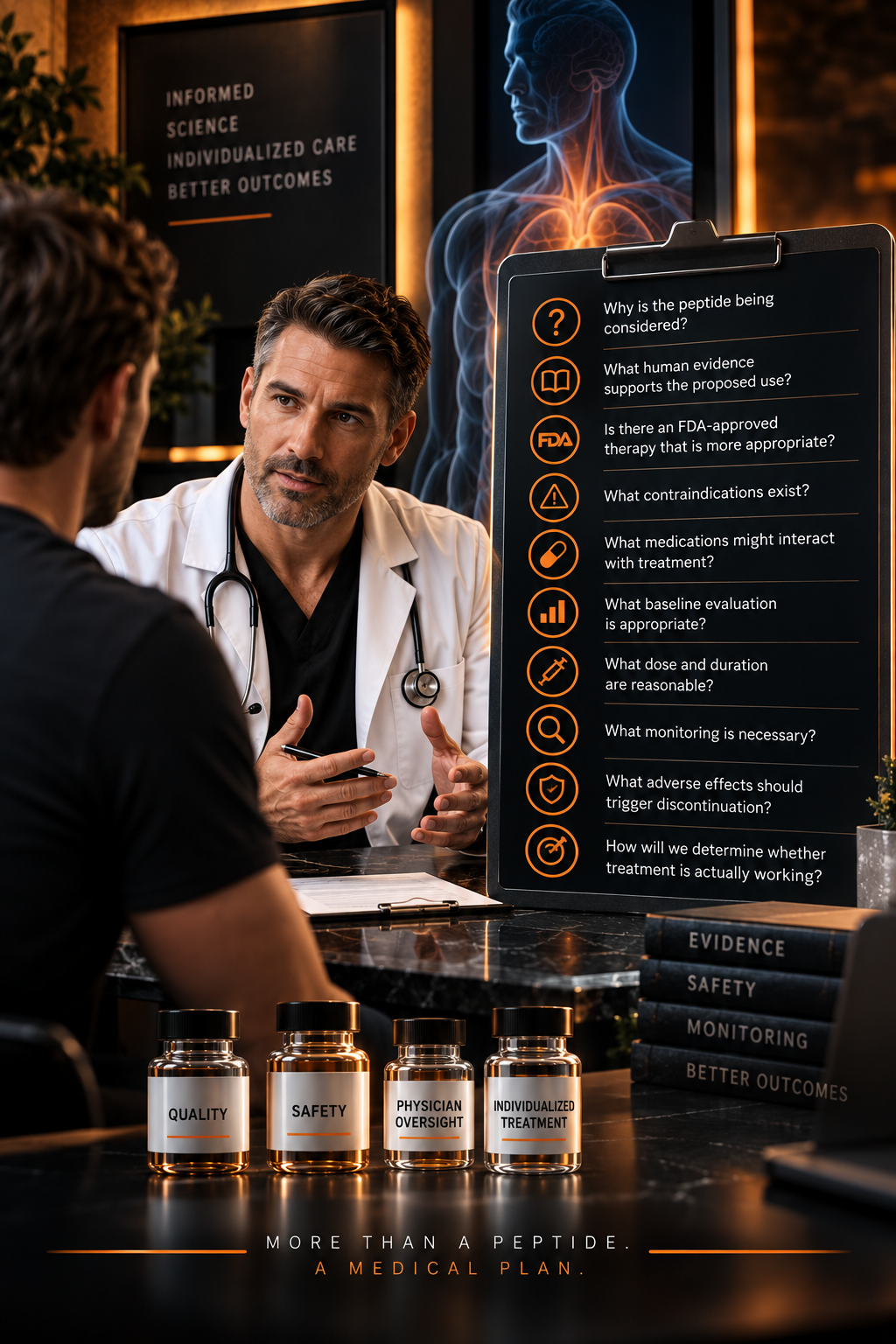
Before considering peptide therapy, an appropriate healthcare professional should evaluate questions such as:
- Why is the peptide being considered?
- What human evidence supports the proposed use?
- Is there an FDA-approved therapy that is more appropriate?
- What contraindications exist?
- What medications might interact with treatment?
- What baseline evaluation is appropriate?
- What dose and duration are reasonable?
- What monitoring is necessary?
- What adverse effects should trigger discontinuation?
- How will we determine whether treatment is actually working?
That last question is particularly important. Treatment should not become:
Prescribe → inject → refill indefinitely.
There should be a clinical goal and a plan for reassessment.
Considering peptide therapy? R2 Medical Clinic offers physician-led peptide therapy evaluation in Denver, Wheat Ridge/Arvada and Castle Rock, built around an individualized review of regulatory status, evidence and clinical goals.
Schedule a consultation or call (720) 640-2333.
FDA Approval, Legal Compounding and Good Medical Care Are Three Different Things
This may be the most important concept for patients to understand. A peptide can be discussed on three separate levels:
- Regulatory status. Is there an FDA-approved drug? If not, is the substance legally eligible for compounding under the applicable circumstances?
- Pharmaceutical quality. Where was the medication prepared? What standards and controls apply to the pharmacy or facility?
- Clinical appropriateness. Is there sufficient evidence and a reasonable medical rationale for this particular patient?
These questions overlap, but they are not interchangeable.
Something can potentially be lawful to compound without having strong evidence for every use. A treatment can have promising scientific evidence without being legally eligible for compounding. And a well-made medication can still be inappropriate for a particular patient.
Questions Patients Should Ask Before Starting Peptide Therapy
Before starting treatment, consider asking:
- Is this an FDA-approved medication or a compounded medication?
- If compounded, why is compounding appropriate?
- Is this being prepared through a 503A pharmacy or a 503B outsourcing facility?
- Is this particular substance currently eligible for compounding?
- What human evidence supports using it for my condition or goal?
- What are the known risks?
- What important risks remain unknown?
- What monitoring will I receive?
- When will treatment be reassessed?
- Where exactly is my medication coming from?
A healthcare professional offering peptide therapy should be comfortable discussing these questions.
The Bottom Line
Peptide regulation cannot accurately be summarized as:
“Peptides are legal.” or: “Peptides are banned.”
Neither statement adequately describes the current regulatory environment.
Some peptide drugs are FDA-approved. Some medications may be appropriately compounded under Sections 503A or 503B when federal requirements are satisfied. Some bulk peptide substances remain under FDA evaluation. Some have raised significant safety concerns. And products sold directly online as “research peptides” may fall entirely outside the legitimate pharmacy dispensing pathway—and labeling something “research use only” does not necessarily prevent FDA from treating it as an unapproved drug when it is marketed for human use.
The regulatory status of an individual peptide therefore needs to be evaluated individually and currently.
But regulation is only part of responsible peptide therapy. Patients should also understand the evidence supporting the treatment, where their medication comes from, why it is being prescribed, what risks are known and unknown, and how their healthcare professional plans to monitor them.
Peptide therapy should begin with appropriate medical care—not with finding a vial online. If you would like an evaluation, schedule a consultation at any of our three Denver-metro locations.
Related Peptide Therapy Resources
Peptide Therapy: A Physician’s Guide to the Evidence, Potential Benefits, Risks & Limitations
Peptide Therapy for Body Composition and Recovery: What Does the Science Actually Show?
Frequently Asked Questions About Peptide Regulation
Are peptides legal?
There is no single legal status that applies to all peptides. Some peptide medications are FDA-approved. Others may be legally compounded under specific circumstances through a 503A pharmacy or 503B outsourcing facility. Other substances may not currently be eligible for compounding, and products sold online as “research peptides” may fall outside the traditional prescription and pharmacy system.
The regulatory status of the specific peptide, formulation and source must therefore be evaluated individually and currently.
Are compounded peptides FDA-approved?
No. Compounded medications are not FDA-approved.
FDA does not review compounded drugs for safety, effectiveness and quality before they are marketed in the same manner as FDA-approved medications. This distinction remains important even when a compounded medication is legitimately prescribed and prepared by an appropriately licensed pharmacy.
What is the difference between a 503A pharmacy and a 503B outsourcing facility?
A 503A pharmacy generally compounds medication for an identified individual patient pursuant to a prescription and operates within both state and federal compounding requirements.
A 503B outsourcing facility is registered with FDA and operates under a different federal framework, including current Good Manufacturing Practice requirements. A 503B facility may compound certain medications without first receiving a patient-specific prescription.
Neither designation means that the compounded medication itself is FDA-approved.
Can a 503A pharmacy compound any peptide if a physician writes a prescription?
No.
A prescription does not automatically make a substance eligible for compounding. Federal law places restrictions on the bulk drug substances that may be used in 503A compounding, and FDA policies concerning individual substances can change.
Does “Category 1” mean a peptide is FDA-approved?
No.
Historically, Category 1 identified certain bulk substances nominated for FDA evaluation that could fall under an interim enforcement policy while FDA considered them. Category 1 status was not FDA approval and did not mean FDA had determined that the substance was safe or effective.
FDA revised this interim policy in January 2025 and no longer intends to place newly nominated substances into Categories 1, 2 or 3.
If a peptide was removed from FDA’s Category 2 list, does that mean FDA determined it is safe?
No.
Removal from Category 2 should not automatically be interpreted as a finding that a substance is safe, effective or FDA-approved. The reason for the change matters. For example, several peptide-related substances were removed from previous FDA categories in 2026 after their nominations were withdrawn, while FDA continued evaluating related substances through other regulatory processes.
Is BPC-157 FDA-approved?
No. BPC-157 is not an FDA-approved drug.
Its regulatory history has changed over time, including previous placement in FDA’s Category 2 materials, withdrawal of an earlier nomination, and subsequent FDA consideration of BPC-157-related bulk substances. These regulatory developments should not be confused with FDA approval.
Are peptides labeled “research use only” safe to inject?
A product labeled “research use only,” “for laboratory use only” or “not for human consumption” should not be assumed to be a medication appropriate for human administration.
These products may be sold outside the traditional prescription and pharmacy system. Injectable products also raise particular concerns because injection bypasses several of the body’s natural defenses against microorganisms and contaminants.
Does a Certificate of Analysis prove that an online peptide is safe?
No.
A Certificate of Analysis may provide information about the particular sample that was tested, depending on the testing performed. It does not make the product FDA-approved, establish that the seller is a licensed pharmacy, or determine that the product is appropriate for human administration.
Quality also involves more than the stated concentration or purity of the active ingredient.
Is a 503B compounded peptide safer than a 503A compounded peptide?
The regulatory frameworks are different, but the designation alone should not be used as a simple measure of whether one particular medication is “safer” than another.
503B outsourcing facilities are FDA-registered and subject to additional federal manufacturing requirements, including current Good Manufacturing Practice requirements. 503A pharmacies operate under a different framework centered largely around patient-specific compounding.
The quality and appropriateness of a particular medication depend on multiple factors, including the substance, formulation, facility, applicable regulatory requirements and individual patient circumstances.
If a pharmacy compounds a peptide, does that mean it is legal and FDA-approved?
Not necessarily—and these are actually two different questions.
A pharmacy’s willingness to compound a medication does not make that medication FDA-approved. It also does not eliminate the need to determine whether the particular bulk substance is eligible for compounding under current federal law and FDA policy.
Can a peptide be legally compounded but still have limited clinical evidence?
Yes.
Regulatory eligibility and clinical evidence are separate issues. A substance’s regulatory status does not establish that strong clinical evidence supports every proposed use.
Likewise, promising scientific research does not by itself establish that a substance is legally eligible for compounding.
Why does physician oversight matter if the peptide comes from a legitimate pharmacy?
Pharmaceutical quality is only one part of medical treatment.
An appropriate healthcare professional should determine why treatment is being considered, evaluate available human evidence, consider FDA-approved alternatives, identify contraindications and medication interactions, establish an appropriate dose and duration, determine what monitoring is necessary, and reassess whether treatment is achieving its intended clinical goal.
The source of the medication matters, but so does the medical care surrounding it.
How can I find out whether a particular peptide can currently be compounded?
Because FDA policies and the regulatory status of individual bulk substances can change, current status should be checked for the specific peptide and formulation being considered.
Patients should ask their healthcare professional and dispensing pharmacy what regulatory pathway applies, why compounding is appropriate, and whether the particular substance is currently eligible for compounding.
What should I ask before starting peptide therapy?
Start with three basic questions:
What am I receiving? Is it FDA-approved or compounded?
Where is it coming from? Is it being dispensed through an appropriate pharmacy or outsourcing facility?
Why am I taking it? What human evidence supports the proposed use, what are the known and unknown risks, and how will my healthcare professional determine whether treatment is working?
Peptide therapy should involve both pharmaceutical quality and appropriate medical oversight.
About the Medical Reviewer
Erik Natkin, DO, is the founder of R2 Medical Clinic, a physician-led medical practice serving Denver, Wheat Ridge/Arvada and Castle Rock, Colorado. His clinical practice includes individualized hormone optimization, physician-supervised medical weight management, peptide therapy and other areas of wellness medicine.
This article is intended for general educational purposes and does not constitute individual medical advice, diagnosis or treatment. Compounded medications are not FDA-approved, and FDA does not review compounded drugs for safety, effectiveness or quality before marketing in the same manner as FDA-approved drugs. Federal and state laws and FDA policies concerning compounding can change. The regulatory status, available evidence, risks and appropriateness of individual peptides should be evaluated individually and currently. Treatment decisions should be made with an appropriately licensed healthcare professional.
Medical References
- U.S. Food and Drug Administration. Compounding and the FDA: Questions and Answers.
- U.S. Food and Drug Administration. FD&C Act Provisions That Apply to Human Drug Compounding.
- U.S. Food and Drug Administration. Bulk Drug Substances Used in Compounding Under Section 503A of the FD&C Act.
- U.S. Food and Drug Administration. Interim Policy on Compounding Using Bulk Drug Substances Under Section 503A of the FD&C Act; Guidance for Industry.
- U.S. Food and Drug Administration. Certain Bulk Drug Substances for Use in Compounding That May Present Significant Safety Risks.
- U.S. Food and Drug Administration. July 23–24, 2026 Meeting of the Pharmacy Compounding Advisory Committee.
- U.S. Food and Drug Administration. Understanding the Risks of Compounded Drugs.
- U.S. Food and Drug Administration. Human Drug Compounding Policies and Rules.