TRT & Estradiol: Why Men Need Estrogen and When Levels Matter
Why men need estradiol, why it rises on TRT, when high or low estrogen matters, gynecomastia, aromatase inhibitors and testing — a physician's guide.
Erik Natkin, DO • 16 min read

Medically reviewed by Erik Natkin, DO — Founder, R2 Medical Clinic, Denver, Colorado
Last medically reviewed: August 2026
When men think about hormones, testosterone usually gets most of the attention. Estrogen is often viewed as a “female hormone”—and in men receiving testosterone replacement therapy (TRT), an elevated estradiol result can sometimes create unnecessary concern.
But men need estrogen too.
In fact, estradiol—the primary biologically active estrogen in men—plays important roles in bone health, sexual function, body composition, cardiovascular physiology, and other aspects of male health.
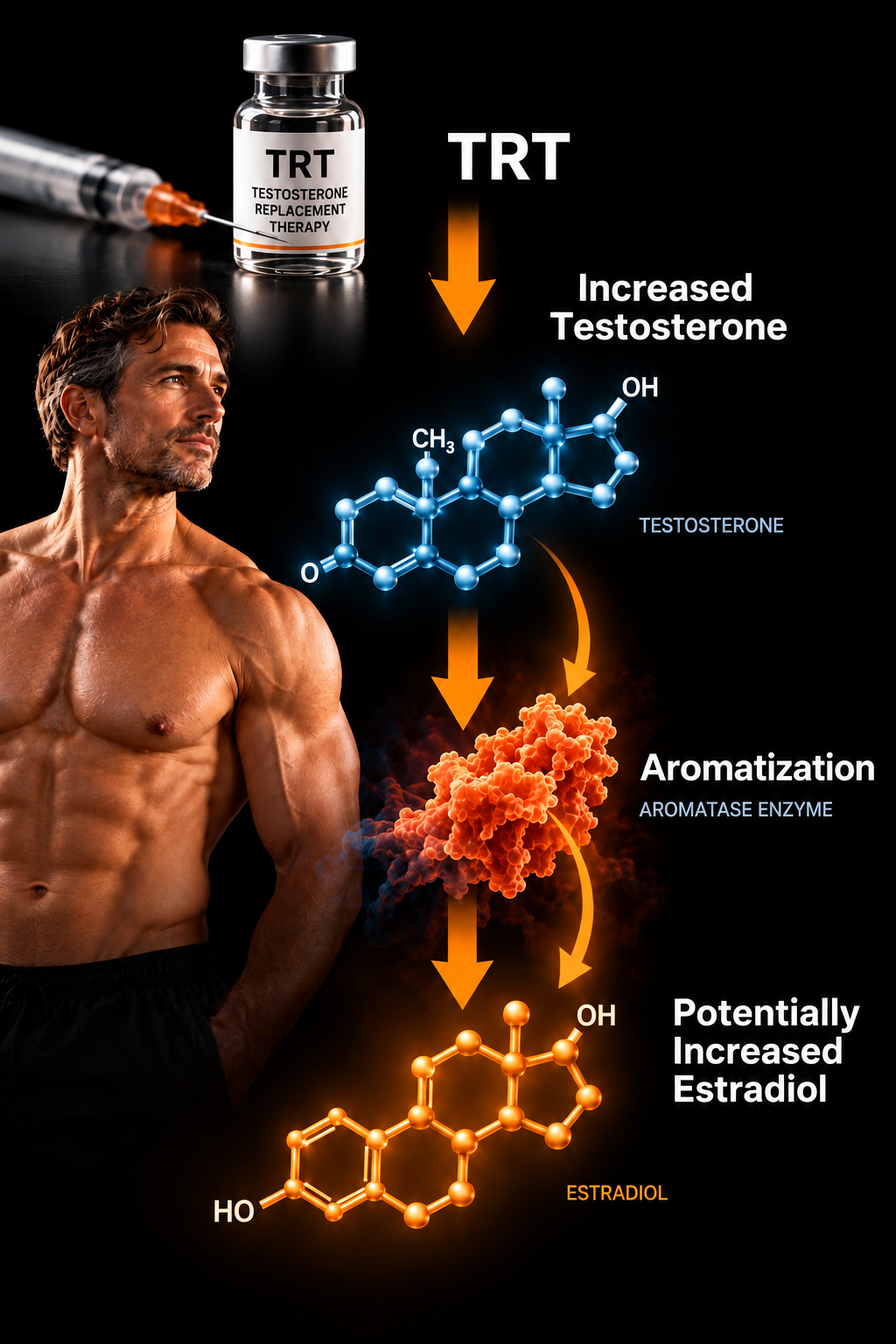
Testosterone and estradiol are also closely connected. A portion of testosterone is naturally converted into estradiol through an enzyme called aromatase. When testosterone levels increase during TRT, estradiol may increase as well.
That increase is not automatically a problem.
The more important question is whether an estradiol level is appropriate for the individual patient and whether it is associated with clinically meaningful symptoms.
Understanding that distinction can help prevent one of the common mistakes in testosterone therapy: treating a laboratory number rather than treating the patient.
Estrogen Is More Than One Hormone
Estrogen is actually a family of related hormones rather than a single hormone. The four naturally occurring estrogens are estrone (E1), estradiol (E2), estriol (E3), and estetrol (E4).
Estradiol (E2) is the most biologically potent and clinically relevant estrogen in adult men and is generally the estrogen measured when evaluating men receiving testosterone therapy.
Estrone (E1) is a weaker estrogen that can be formed from androstenedione and can also be converted back and forth with estradiol. Like estradiol, some estrone production occurs in peripheral tissues, including adipose tissue.
Estriol (E3) is a much weaker estrogen and is primarily associated with pregnancy, when it is produced in substantially greater quantities. It generally has limited relevance when evaluating estrogen status in adult men.
Estetrol (E4) is another naturally occurring estrogen produced primarily by the fetal liver during pregnancy. Outside of pregnancy, men do not normally produce clinically meaningful amounts of E4, and it is not part of routine hormone evaluation in men.
For men receiving TRT, the estrogen that usually matters most clinically is therefore estradiol (E2). When a clinician orders an “estradiol” level, the goal is not to measure all forms of estrogen but to evaluate the estrogen with the greatest relevance to male physiology and testosterone therapy.
What Is Estradiol?
Estradiol, often abbreviated E2, is the most biologically active form of estrogen.
Although women generally have substantially higher estradiol concentrations than men, estrogen is still an important part of normal male physiology.
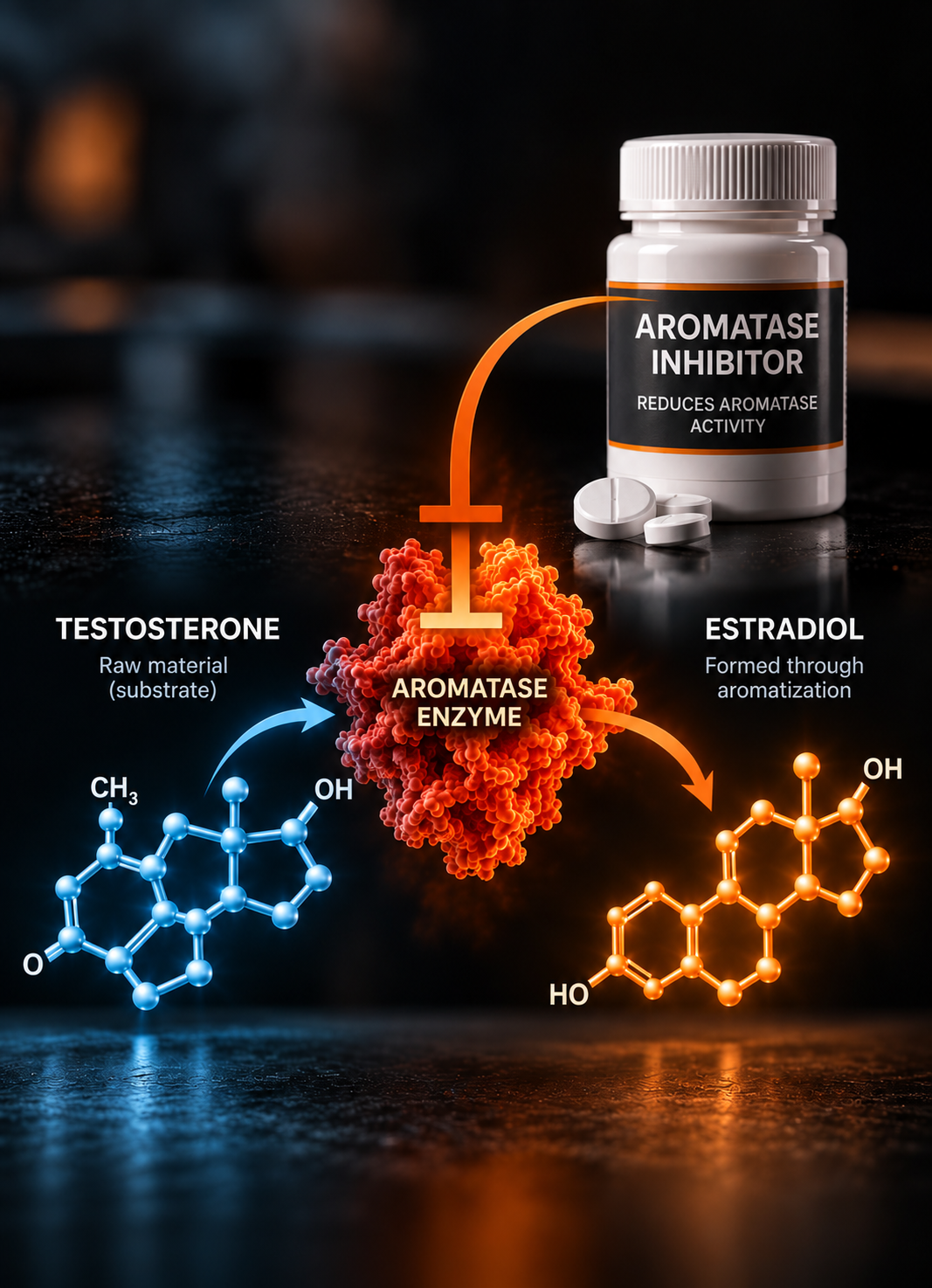
Most estradiol in men does not come directly from the testes. Instead, much of it is produced when testosterone is converted into estradiol by the enzyme aromatase. This process is known as aromatization.
Aromatase is present in several tissues, including:
- Adipose tissue
- Bone
- Brain
- Testicular tissue
- Other peripheral tissues
This means testosterone and estradiol are not competing hormones. They are part of an interconnected hormonal system.
Why Do Men Need Estrogen?

The goal of testosterone therapy should not be to eliminate estrogen. Normal estrogen signaling contributes to several important physiological functions in men.
Bone Health
Estradiol plays a major role in maintaining male bone density.
Research involving men with impaired estrogen production or estrogen signaling helped demonstrate that estrogen is essential for normal skeletal development and maintenance. Low estrogen exposure can contribute to increased bone turnover and loss of bone mineral density.
This becomes particularly important as men age, when maintaining bone strength can help reduce the long-term risk of osteoporosis and fractures.
Sexual Function
Testosterone is clearly important for male sexual function, but estradiol also plays an important role. Research suggests that both testosterone and estradiol contribute to sexual desire and sexual function in men.
The relationship is not simply that “more estrogen is better” or “less estrogen is better.” Both excessively low and elevated estradiol may be associated with sexual dysfunction. In some men, higher estradiol levels may be associated with decreased libido, difficulty achieving or maintaining erections, or changes in overall sexual function. Conversely, suppressing estradiol too aggressively may also negatively affect libido and sexual function.
This is another reason estradiol should be evaluated in context rather than automatically suppressed whenever it rises during TRT. Sexual dysfunction is multifactorial, and testosterone, estradiol, vascular health, medications, psychological factors, sleep, metabolic health, and other hormonal abnormalities may all contribute.
Body Composition
Testosterone and estradiol both influence body composition. Testosterone has important effects on lean muscle mass, while estrogen appears to participate in regulation of body fat.
Research examining hormonal suppression and replacement in men has demonstrated that estrogen deficiency can contribute to increases in body fat even when testosterone is being considered separately.
Brain and Mood
Estrogen receptors are present throughout the male brain. Estradiol participates in neuroendocrine signaling and may influence mood, cognition, sexual behavior, and overall well-being.
These relationships are complex, however, and symptoms such as fatigue, anxiety, irritability, or changes in mood should not automatically be attributed to estradiol.
Cardiovascular and Vascular Health
Estradiol also appears to play a role in cardiovascular and vascular health in men. Estrogen receptors are present in blood vessels and cardiovascular tissues, and estradiol participates in processes involving endothelial function, nitric oxide signaling, vascular tone, inflammation, and lipid metabolism.
Some research suggests that inadequate estrogen activity in men may adversely affect vascular function and potentially contribute to cardiovascular risk. However, the relationship is complex. Higher estradiol levels are not necessarily more protective, and elevated estradiol can sometimes be associated with obesity, metabolic dysfunction, or other conditions that independently increase cardiovascular risk.
For this reason, estradiol should not be viewed simply as either “cardioprotective” or “cardiovascularly harmful.” Rather, normal estrogen signaling appears to be one component of healthy male cardiovascular physiology, providing another reason to avoid unnecessarily suppressing estradiol during testosterone therapy.
Why Does Estradiol Increase During TRT?
One of the most common reasons estradiol rises during testosterone therapy is simply that more testosterone is available for aromatization.
Think of testosterone as the raw material. If more testosterone is circulating, there may be more substrate available for aromatase to convert into estradiol.
This is a normal physiological pathway. The magnitude of the increase varies significantly from person to person.
This does not necessarily mean estradiol is “too high” or needs to be treated. As testosterone levels increase, some rise in estradiol may be an expected physiological response. The clinical significance depends on the degree of elevation, the patient’s symptoms, and the overall hormonal picture—not the estradiol number alone.
TRT → increased testosterone → increased aromatization → potentially increased estradiol
Body Fat and Aromatization
Body composition can also influence estrogen production. Adipose tissue contains aromatase. Men with greater amounts of body fat may therefore have greater aromatase activity and increased conversion of testosterone into estrogen.
This is one reason hormone optimization should not occur in isolation. Improving:
- Body composition
- Nutrition
- Physical activity
- Metabolic health
- Sleep
- Insulin sensitivity
may influence the hormonal environment as well.
For some men, addressing obesity and metabolic health may be more appropriate than immediately adding another medication simply because estradiol increased.
Is a High Estradiol Level During TRT Dangerous?
Not necessarily. This is where interpretation becomes important.
An estradiol result above a laboratory’s reference range does not automatically mean that a man has a medical problem or requires treatment. Reference ranges are useful, but they are not perfect treatment thresholds.
A man receiving TRT may have testosterone concentrations substantially different from those of the population used to establish a laboratory’s reference interval. Because testosterone provides the substrate from which estradiol is produced, the relationship between the two hormones matters.
Estradiol should therefore be interpreted in context. That includes considering:
- Estradiol level
- Total testosterone
- Free testosterone
- SHBG
- TRT dose
- Timing of laboratory testing
- Injection frequency or treatment modality
- Body composition
- Medications
- Symptoms
- Changes over time
A laboratory value is one piece of the clinical picture—not the entire picture. See TRT Bloodwork Explained for how testosterone, free testosterone, SHBG, estradiol and other results are interpreted together.
Symptoms Sometimes Associated with Higher Estradiol
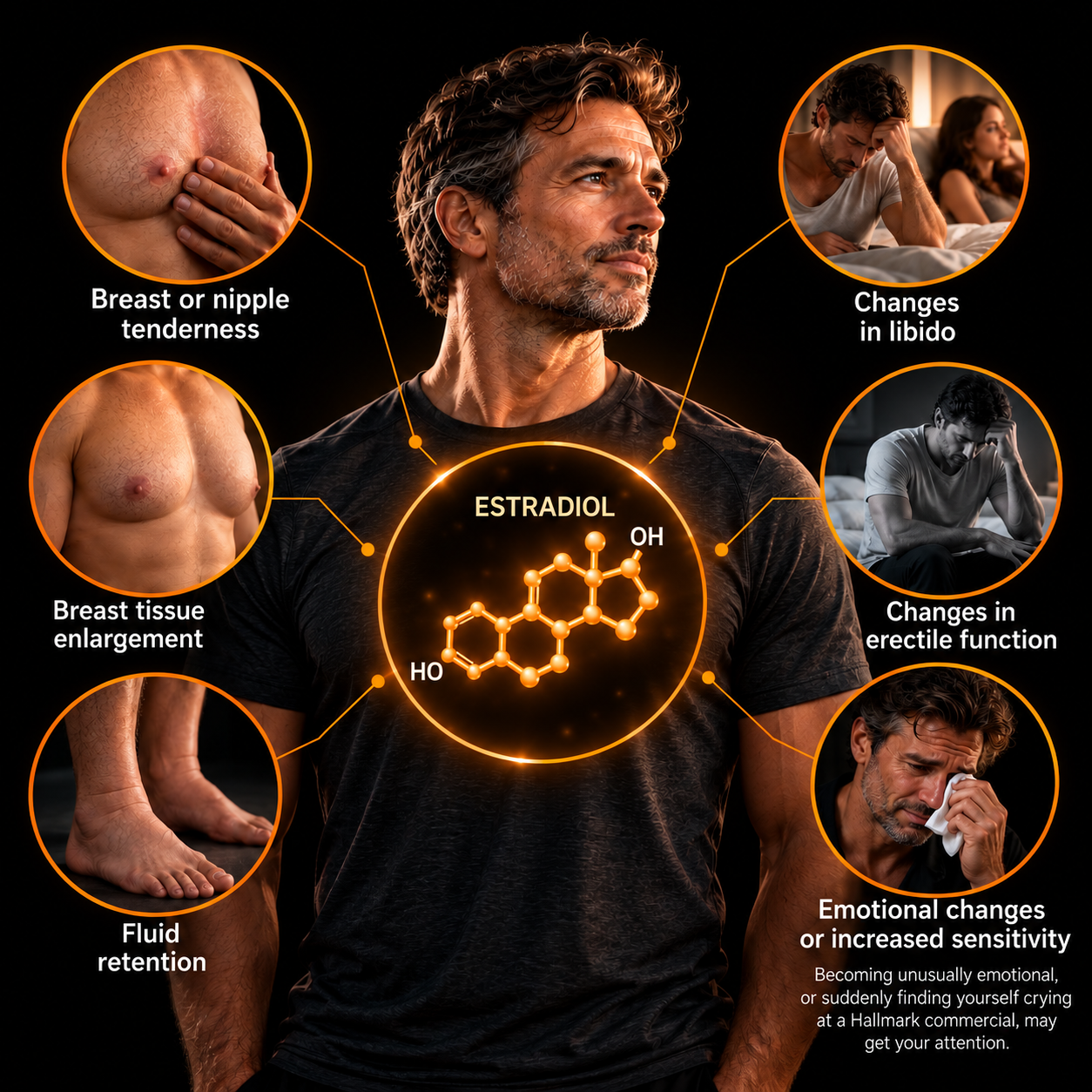
When estradiol becomes elevated, some men may experience symptoms. Potential symptoms can include:
- Breast tenderness
- Breast tissue enlargement
- Fluid retention
- Changes in libido
- Changes in erectile function
- Emotional changes or increased sensitivity. Becoming unusually emotional, or suddenly finding yourself crying at a Hallmark commercial, may get your attention, but emotional changes alone do not prove that estradiol is elevated.
However, these symptoms are not specific to estradiol.
For example, changes in libido or erectile function can also be influenced by testosterone levels, prolactin, thyroid function, medications, vascular disease, psychological factors, sleep, stress, and relationship factors.
Symptoms should therefore trigger a broader clinical evaluation rather than an automatic assumption that estrogen is responsible.
Gynecomastia and Estradiol
One of the most common concerns men have about elevated estrogen during TRT is gynecomastia, the development of glandular breast tissue in males.
Gynecomastia is different from simply carrying excess fat in the chest. Increased chest fat, sometimes called pseudogynecomastia, is primarily adipose tissue. True gynecomastia involves proliferation of glandular breast tissue and may initially present as breast tenderness, swelling, or a firm or rubbery area of tissue beneath or around the nipple. Some men may also notice increased nipple sensitivity. It can occur on one or both sides.
Estrogen stimulates breast tissue, while androgens such as testosterone generally oppose this effect. For this reason, gynecomastia is influenced not simply by whether estradiol is “high,” but by the relative balance of estrogen and androgen activity within breast tissue. During TRT, increasing testosterone provides more substrate for aromatization into estradiol, but an elevated estradiol laboratory value does not automatically mean that gynecomastia will develop.
Body composition can also matter. Adipose tissue contains aromatase, so men with higher amounts of body fat may have greater peripheral conversion of androgens into estrogens. Other potential contributors to gynecomastia include certain medications, alcohol or drug use, liver or kidney disease, thyroid disorders, testicular conditions, and other hormonal abnormalities.
Early symptoms such as persistent breast tenderness or development of new breast tissue should be evaluated rather than automatically treated by attempting to drive estradiol lower. The underlying cause, testosterone dose, estradiol level, other medications, and the overall hormonal picture should first be considered.
Long-standing gynecomastia may become increasingly fibrotic and less likely to regress, which is another reason persistent or progressive breast changes should not simply be ignored.
A hard or fixed mass, nipple discharge or retraction, skin changes, enlarged lymph nodes, or a distinctly unilateral breast mass warrants medical evaluation to exclude other causes, including the uncommon possibility of male breast cancer.
The balance between androgen and estrogen activity is important. Other potential contributors include:
- Obesity
- Certain medications
- Liver disease
- Thyroid disorders
- Testicular disorders
- Other hormonal abnormalities
New breast enlargement, persistent nipple tenderness, a breast mass, or unilateral changes should be medically evaluated rather than assumed to be a routine side effect of TRT.
Can Estradiol Be Too Low?
Absolutely. This is one of the most important—and sometimes overlooked—parts of managing estrogen during testosterone therapy.
If estradiol is aggressively suppressed, men may experience problems associated with estrogen deficiency. Potential symptoms or consequences can include:
- Reduced libido
- Sexual dysfunction
- Joint discomfort
- Changes in mood
- Possible adverse effects on bone health
- Changes in body composition
Extremely low estradiol is not the goal of testosterone therapy.
The objective is hormonal balance, not estrogen elimination.
What Are Aromatase Inhibitors?
Aromatase inhibitors, often called AIs, or sometimes referred to by the somewhat misleading term “estrogen blockers,” are medications that reduce the activity of the aromatase enzyme. By inhibiting aromatase, these medications reduce conversion of testosterone into estradiol. Examples include medications such as anastrozole.
Aromatase inhibitors have legitimate medical uses. However, their use in men receiving TRT requires thoughtful consideration.
Lowering estradiol simply because a laboratory value is elevated may not improve how a patient feels—and excessive suppression can potentially create a different set of problems.
Does Every Man with Elevated Estradiol Need an Aromatase Inhibitor?
No. An elevated estradiol result alone does not necessarily establish a need for treatment.
Before considering additional medication, it may be appropriate to evaluate why estradiol is elevated and whether the patient actually has clinically meaningful symptoms.
Depending on the situation, a physician may evaluate:
- Whether the testosterone dose is appropriate
- Whether testosterone levels are excessively high
- Timing of injections
- Frequency of injections
- Peak and trough hormone concentrations
- Body composition
- Alcohol intake
- Other medications
- Liver function
- Other hormonal abnormalities
Sometimes adjusting the testosterone regimen itself may be more appropriate than immediately adding another medication.
Testosterone Dose and Estradiol
More testosterone is not always better.
If a TRT regimen produces testosterone concentrations substantially above the intended treatment range, there may also be increased conversion to estradiol. This is one reason properly managed testosterone therapy requires ongoing laboratory monitoring and dose adjustment.
The goal should generally be to use the appropriate dose needed to achieve the desired clinical response while minimizing unnecessary adverse effects. Increasing testosterone indefinitely in pursuit of a higher laboratory number can create problems that might otherwise have been avoided.
Injection Frequency May Matter
Testosterone concentrations can fluctuate depending on the medication, dose, route of administration, and dosing schedule.
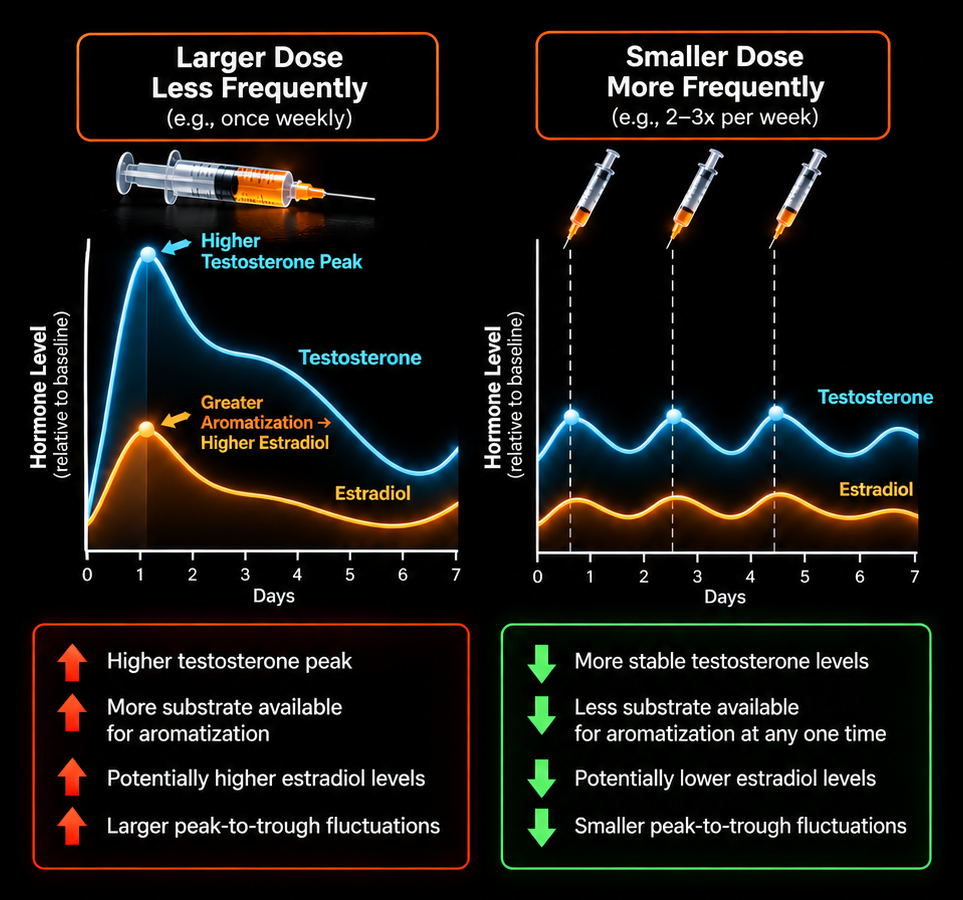
With injectable testosterone, larger doses given less frequently may produce higher peaks followed by lower troughs. These higher testosterone peaks may provide more substrate for aromatization and, in some men, contribute to increased conversion of testosterone to estradiol.
In some patients, dividing the total dose into smaller, more frequent injections may produce more stable testosterone concentrations and potentially reduce excessive conversion of testosterone to estradiol.
Whether this meaningfully improves estradiol-related symptoms varies by patient, but dosing strategy is one factor worth considering before automatically adding another medication.
The Testosterone-to-Estradiol Ratio
You may encounter discussions online about the “ideal” testosterone-to-estradiol ratio.
Although the relationship between androgen and estrogen activity is physiologically important, there is no universally accepted testosterone-to-estradiol ratio that should automatically determine treatment for every man receiving TRT. Hormonal medicine is more complicated than a single ratio.
A patient with an estradiol concentration of 45 pg/mL and robust testosterone levels may have a very different hormonal environment from someone with the same estradiol concentration and very low testosterone.
This is why numbers should be interpreted together rather than independently.
Measuring Estradiol in Men
Estradiol concentrations in men are considerably lower than those typically found in premenopausal women. Because of these lower concentrations, the testing method matters.
When clinically appropriate, a sensitive estradiol assay, frequently using liquid chromatography-tandem mass spectrometry (LC-MS/MS), may provide more reliable measurement at the lower concentrations typically encountered in men.
The exact test used should be interpreted within the context of the laboratory method and reference interval.
When Should Estradiol Be Checked During TRT?
There is no single laboratory schedule appropriate for every patient.
Estradiol may be particularly useful when a man receiving testosterone develops symptoms potentially related to altered estrogen activity, such as:
- Breast or nipple tenderness
- Gynecomastia
- Unexplained fluid retention
- Significant changes in sexual function
- Symptoms potentially associated with excessive estrogen suppression
It may also be followed when a patient is already receiving medication specifically intended to modify estrogen levels. Routine hormone monitoring during TRT may also include other laboratory measurements depending on the individual patient.
Estradiol Is Only One Part of TRT Monitoring
Proper testosterone management requires more than checking testosterone and estradiol.
Depending on the patient, monitoring may include:
- Total testosterone
- Free testosterone
- SHBG
- Complete blood count and hematocrit
- PSA when clinically appropriate
- Estradiol when indicated
- Metabolic markers
- Lipid profile
- Additional laboratory testing based on symptoms and medical history
Blood pressure, body composition, sleep, cardiovascular risk factors, medication use, fertility goals, and clinical symptoms also matter.
TRT should be managed as medical care—not simply as testosterone dosing.
Fertility Deserves Separate Consideration
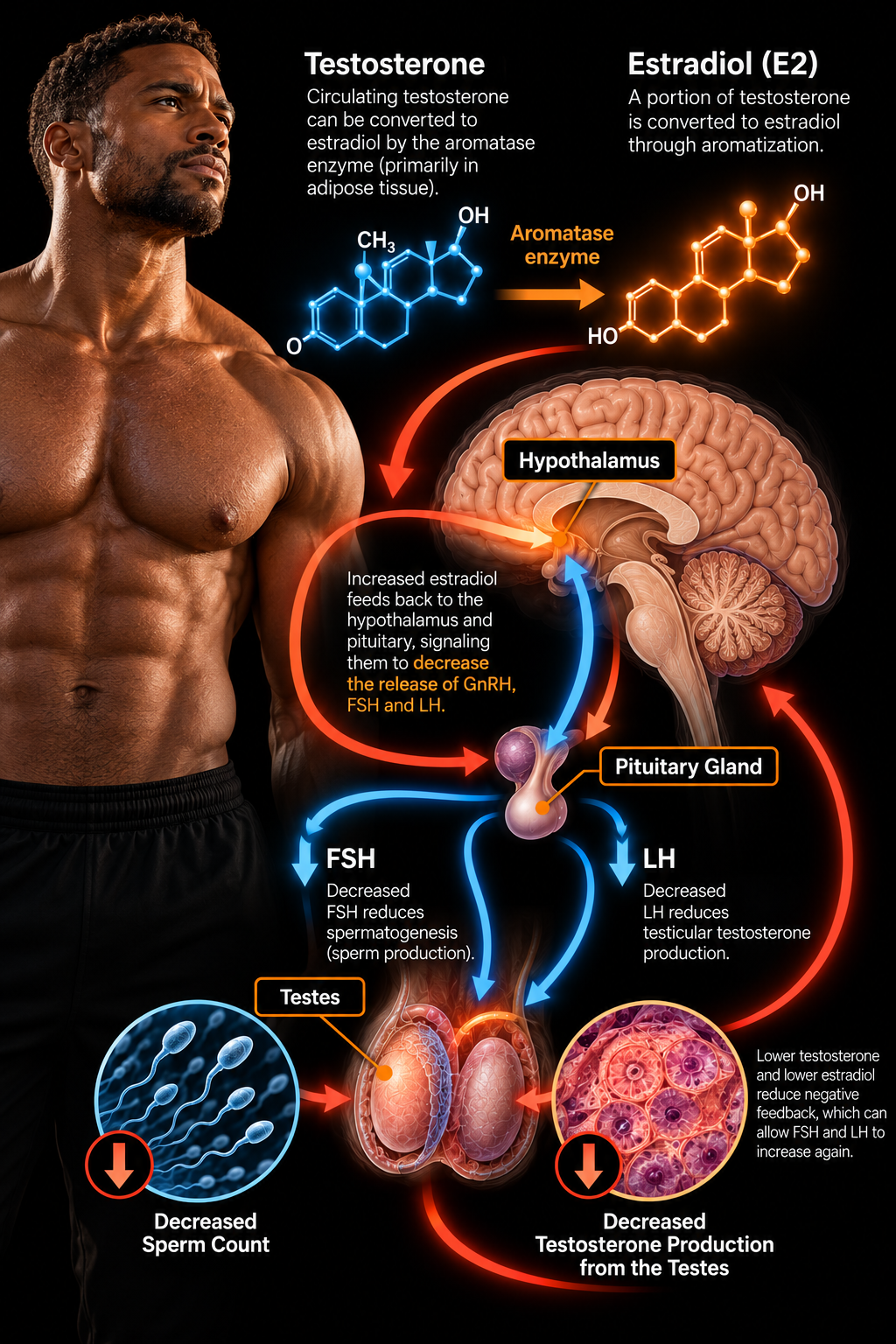
Men considering TRT should also understand that exogenous testosterone can suppress the hypothalamic-pituitary-gonadal (HPG) axis, the hormonal signaling system that regulates the testes.
Normally, the hypothalamus releases gonadotropin-releasing hormone (GnRH), which signals the pituitary gland to release luteinizing hormone (LH) and follicle-stimulating hormone (FSH). LH stimulates the Leydig cells of the testes to produce testosterone, while FSH—together with high concentrations of testosterone within the testes—supports normal sperm production.
When testosterone is supplied from outside the body, rising testosterone and estradiol provide negative feedback to the hypothalamus and pituitary. This can reduce GnRH, LH, and FSH signaling. As a result, intratesticular testosterone can fall substantially, testicular volume may decrease, and sperm production may decline—sometimes to very low levels or even zero sperm in the ejaculate.
Importantly, managing estradiol with an aromatase inhibitor does not eliminate the suppressive effect of exogenous testosterone on the HPG axis.
Men who currently desire fertility—or may want children in the future—should discuss those goals with their physician before beginning testosterone therapy, as fertility-preserving approaches or alternative treatments may be appropriate.
Treat the Patient, Not Just the Estradiol Number
Perhaps the most important principle is simple: a laboratory result should guide clinical decision-making, not replace it.
If a man feels well, has no concerning symptoms, has an appropriate testosterone regimen, and has a modestly elevated estradiol result, automatically suppressing estrogen may not necessarily provide a benefit.
Conversely, persistent symptoms should not be ignored simply because an estradiol result falls within the laboratory reference range.
Symptoms + laboratory results + medical history + physical findings + treatment goals + trends over time
rather than focusing on a single number.
A Practical Approach to Estradiol During TRT
For men receiving testosterone therapy, a reasonable approach includes:
- Expect some estradiol production. Conversion of testosterone into estradiol is normal physiology.
- Do not assume estrogen is the enemy. Men require estrogen for normal biological function.
- Evaluate symptoms carefully. Many symptoms blamed on estrogen have multiple possible causes.
- Look at testosterone dosing first. Excessive testosterone exposure may contribute to unnecessary aromatization.
- Consider body composition and metabolic health. Adipose tissue contributes to aromatase activity.
- Use appropriate laboratory testing. Estradiol measurement in men requires attention to the assay being used.
- Avoid automatically treating a number. An estradiol result outside a laboratory reference interval does not automatically require medication.
- Avoid excessive estrogen suppression. Estradiol has important physiological functions in men.
- Follow trends rather than isolated results. Hormone values are more meaningful when interpreted over time and in relation to treatment.
- Individualize treatment. There is no single testosterone or estradiol number that defines optimal therapy for every man.
The Bottom Line
Estrogen is not simply a female hormone, and estradiol is not an unwanted byproduct of testosterone therapy. Men need estradiol.
It contributes to bone health, sexual function, body composition, vascular health, and normal physiological signaling, and may play a role in maintaining healthy cardiovascular function. Because testosterone is naturally converted into estradiol, an increase in estradiol during TRT can be an expected consequence of treatment.
The challenge is determining when that increase is clinically meaningful.
The goal should not be to drive estradiol as low as possible. Nor should every elevated laboratory result automatically lead to another medication.
Successful testosterone therapy requires understanding the relationship between testosterone, estradiol, symptoms, body composition, dosing, laboratory testing, and the individual patient.
At R2 Medical Clinic, hormone therapy is approached as individualized medical care. Laboratory results are evaluated alongside symptoms, medical history, treatment goals, and overall health to develop a treatment strategy appropriate for each patient.
Related Men’s Hormone Health Resources
Testosterone & Hormone Optimization for Men: A Physician’s Guide
My Testosterone Is Normal—So Why Do I Still Have Symptoms?
TRT Bloodwork Explained: Testosterone, Free Testosterone, SHBG, Estradiol, Hematocrit, PSA & More
Your Health Is More Than a Subscription: Why Quality Medical Care Matters
Erectile Dysfunction Isn’t Always About Testosterone
Frequently Asked Questions
Is estrogen bad for men?
Does TRT increase estradiol?
What is a normal estradiol level for a man on TRT?
Should estradiol always be lowered if it is above the reference range?
Can high estradiol cause gynecomastia?
Can low estradiol cause problems in men?
Do I need an aromatase inhibitor while taking testosterone?
Can losing body fat lower estradiol?
Should men use a sensitive estradiol test?
Is there an ideal testosterone-to-estradiol ratio?
About the Medical Reviewer
Erik Natkin, DO, is the founder of R2 Medical Clinic, a physician-led medical practice serving Denver, Wheat Ridge/Arvada and Castle Rock, Colorado. His clinical practice includes individualized hormone evaluation and optimization for men and women, testosterone therapy, medical weight management and other areas of wellness medicine.
This article is for educational purposes only and is not intended to diagnose, treat, cure, or prevent any medical condition. Testosterone therapy and medications that alter estrogen levels require individualized medical evaluation and monitoring. Laboratory values should be interpreted in the context of symptoms, medical history, medications, physical findings, and other relevant clinical information.
Medical References
- Finkelstein JS, Lee H, Burnett-Bowie SAM, et al. Gonadal steroids and body composition, strength, and sexual function in men. New England Journal of Medicine. 2013;369:1011-1022.
- Falahati-Nini A, Riggs BL, Atkinson EJ, O’Fallon WM, Eastell R, Khosla S. Relative contributions of testosterone and estrogen in regulating bone resorption and formation in normal elderly men. Journal of Clinical Investigation. 2000;106(12):1553-1560.
- Rochira V, Balestrieri A, Madeo B, et al. Congenital estrogen deficiency in men: a new syndrome with different phenotypes; clinical and therapeutic implications in men. Molecular and Cellular Endocrinology. 2002;193(1-2):19-28.
- Bhasin S, Brito JP, Cunningham GR, et al. Testosterone therapy in men with hypogonadism: An Endocrine Society Clinical Practice Guideline. Journal of Clinical Endocrinology & Metabolism. 2018;103(5):1715-1744.
- Mulhall JP, Trost LW, Brannigan RE, et al. Evaluation and management of testosterone deficiency: AUA Guideline. Journal of Urology. 2018;200(2):423-432.
- Khosla S, Oursler MJ, Monroe DG. Estrogen and the skeleton. Trends in Endocrinology & Metabolism. 2012;23(11):576-581.