Your Health Is More Than a Subscription: Why Quality Medical Care Matters
Access to medication isn't medical care. A physician explains why evaluation, monitoring, medication sourcing and accountability matter more than price.
Erik Natkin, DO • 24 min read

Medically reviewed by Erik Natkin, DO — Founder, R2 Medical Clinic, Denver, Colorado
Last medically reviewed: September 2026
Healthcare has never been more convenient.
Today, patients can go online, complete a questionnaire, have a virtual consultation and potentially have medication shipped directly to their home.
At the same time, information about hormones, weight loss, peptides, supplements and performance has become readily available through social media, podcasts, fitness communities, personal trainers, nutrition professionals, friends and online forums.
Some of this information can be extremely helpful. Some of it can be misleading or even dangerous.
But access to information—and access to medication—should not be confused with medical care.
Whether you are considering hormone therapy, medical weight loss, peptide therapy, treatment for sexual dysfunction or another ongoing medical treatment, there is a more important question than:
“Where can I get this for the lowest price?”
The better question is:
The Lowest Price Is Not Always the Lowest Cost
Cost matters. Patients should understand what they are paying for, compare their options and avoid unnecessary healthcare expenses.
But healthcare is one area where the cheapest option is not necessarily the best value.
A lower price may reflect efficiency and lower overhead. But it can also reflect differences that are much less obvious: less medical evaluation, less follow-up, limited access to a healthcare professional, minimal laboratory monitoring, different medication sourcing, or a business model built primarily around selling and refilling medication.
Those differences matter.
If you are comparing two programs that appear to offer the same hormone, weight-loss medication, peptide or other treatment, you may not actually be comparing the same thing.
You are not simply purchasing a vial, tablet or prescription.
You are choosing who evaluates you, who monitors you, where your medication comes from, what happens when something goes wrong and who ultimately accepts responsibility for your medical care.
Saving money is important. But saving money by sacrificing medication quality or appropriate medical oversight can be a very different kind of bargain.
Your health deserves more consideration than simply finding the lowest monthly price.
Medicine Should Be More Than a Transaction
There is an important difference between access to medication and medical care.
A transactional model can look something like this:
Questionnaire → brief consultation → prescription → medication → automatic refill
Good medical care should involve considerably more.
Depending upon the treatment and the individual patient, appropriate care may include:
- Medical history
- Current medications
- Previous treatments
- Family history
- Allergies
- Vital signs
- Physical examination when appropriate
- Laboratory testing
- Individual risk factors
- Treatment goals
- Follow-up
- Monitoring for adverse effects
- Reassessment of whether treatment should continue
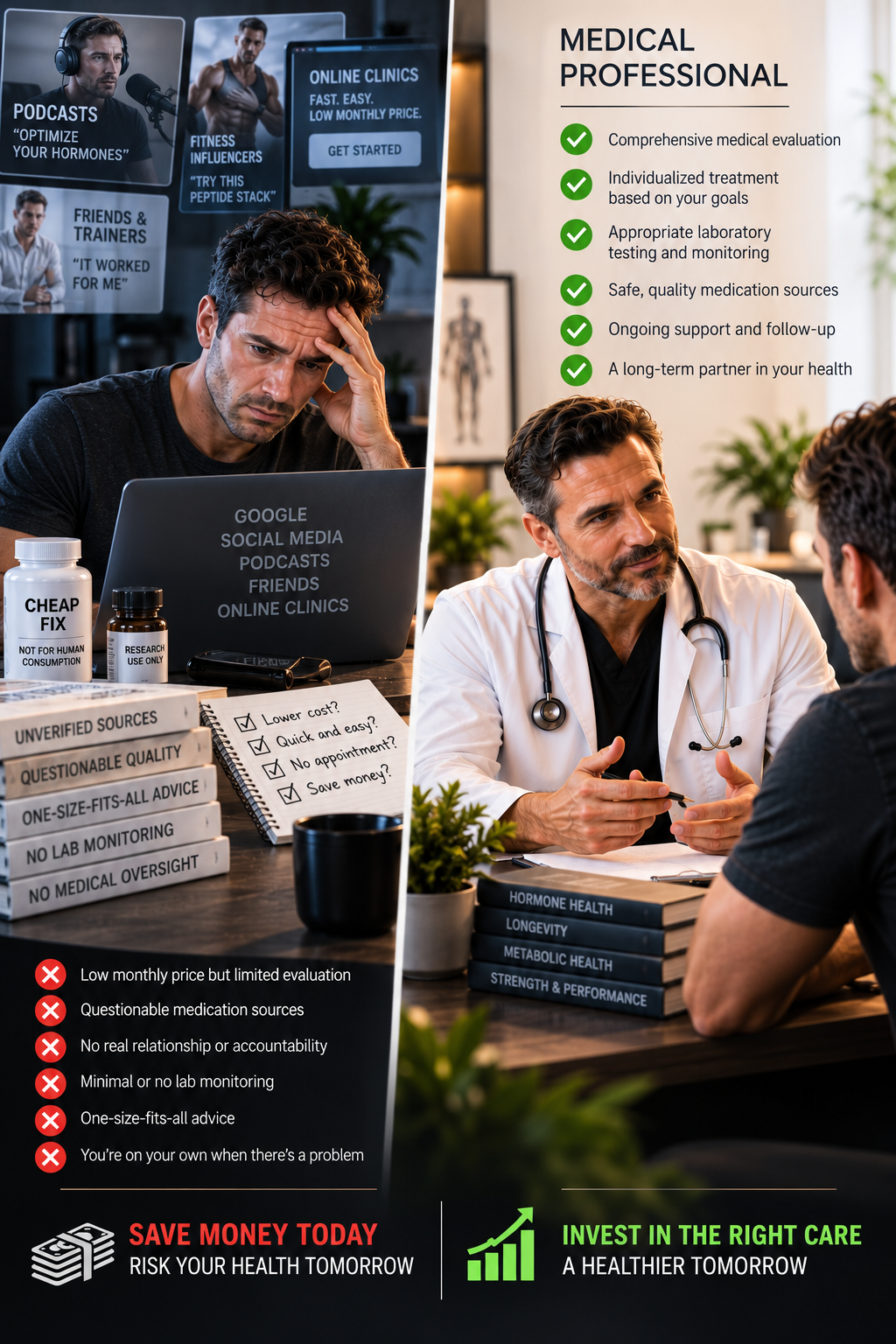
The medication is only one part of that process.
The goal of medicine should not simply be to get a patient onto a medication.
The goal should be to determine what treatment, if any, is appropriate and then manage that treatment responsibly.
Telemedicine Is a Tool—Not a Standard of Quality
Telemedicine itself is not the problem.
Excellent physicians and other healthcare professionals can provide appropriate care through telemedicine. Virtual visits can improve access, eliminate unnecessary travel and make follow-up considerably easier.
Likewise, simply having a physical office does not guarantee high-quality medical care.
The important distinction is how the patient is being treated.
A high-quality telemedicine practice may provide comprehensive evaluation, appropriate laboratory testing, careful prescribing and meaningful follow-up.
The concern arises when healthcare becomes primarily transactional—particularly when the relationship revolves around obtaining and refilling a medication.
Patients should ask themselves:
Am I receiving medical care that happens to be delivered online?
Or:
Am I primarily purchasing access to a medication?
Those are very different relationships.
There Is Value in Having a Provider Who Knows You
Medicine works best when there is continuity.
A healthcare professional who follows you over time develops an understanding of your health that can be difficult to reproduce through isolated encounters.
Your provider may know:
- What your baseline laboratory values looked like
- How you responded to previous treatments
- Which side effects you experienced
- Which medications did not work
- How your blood pressure has changed
- How your weight and body composition have changed
- How your symptoms have evolved
- What other medical problems have developed
- What your treatment goals actually are

Over time, those individual pieces become part of a larger clinical picture.
A laboratory value that looks acceptable in isolation may have greater significance when compared with that patient’s previous results.
A new symptom may mean more to a clinician who knows what the patient looked and felt like six months earlier.
Continuity is not simply convenient. It can be an important part of good medical care.
Your Trainer, Nutrition Professional, Podcast Personality or “Dr.,” Coach or Friend Can Be Valuable—But Their Role Is Different
Many patients receive health and fitness guidance from people they know and trust.
A knowledgeable personal trainer can be invaluable for developing an appropriate exercise program.
A qualified nutrition professional can help patients improve eating habits, protein intake and overall nutrition.
Podcasts and online health educators—including popular voices such as Joe Rogan and Andrew Huberman, PhD—can be valuable sources of information and discussion, but they are not substitutes for individualized medical care. A PhD is an advanced academic degree, not a medical degree, and should not be confused with an MD or DO. Most importantly, a podcast personality, researcher, influencer or online educator who discusses a treatment is not examining you, reviewing your complete medical history, prescribing the treatment, monitoring your response or assuming professional responsibility for your medical care. Information can help you ask better questions, but medical decisions should be made with a qualified healthcare professional who knows your health and is accountable for the care provided.
A strength coach or experienced bodybuilder may have years of practical experience with training, recovery and body composition.
Friends and family members can provide motivation, encouragement and valuable support.
These people can all be important members of someone’s health and wellness journey.
But their roles are different from the role of a licensed healthcare professional.
Personal experience—even extensive experience—is not the same as medical education and clinical training.
Someone may know a great deal about building muscle, losing body fat or improving athletic performance without having the training necessary to evaluate:
- Cardiovascular risk
- Medication interactions
- Abnormal laboratory results
- Endocrine disorders
- Kidney or liver disease
- Hematologic abnormalities
- Contraindications to treatment
- Adverse medication effects
- Symptoms that may represent an unrelated medical condition
- When treatment should be modified or discontinued

This distinction becomes especially important when the conversation moves from exercise, nutrition and lifestyle into prescription medications, hormones, peptides or other medical therapies.
Experience Is Valuable—But It Is Not the Same as Medical Training
A recommendation may sound convincing because someone has personally used a treatment.
You may hear:
- “I’ve taken this for years.”
- “Everyone at my gym uses it.”
- “This worked great for me.”
- “I’ve coached hundreds of people who have used this.”
Those experiences can be genuine.
But an individual’s response to a treatment cannot determine whether that treatment is appropriate for someone else.
Two people of similar age, fitness level and body composition may have very different medical histories, medications, cardiovascular risks, laboratory abnormalities and underlying health conditions.
Something that appeared to work well for one person may be inappropriate for another.
Personal experience can provide perspective. It cannot replace individualized medical evaluation.
Medical Accountability Matters
There is another important distinction between medical care and informal advice: accountability.
A healthcare professional who prescribes treatment assumes professional responsibility for that decision.
That includes responsibilities surrounding:
- Patient evaluation
- Appropriate prescribing
- Documentation
- Informed consent
- Monitoring
- Recognition of adverse effects
- Appropriate follow-up
- Referral when necessary
- Modification or discontinuation of treatment when appropriate

Licensed healthcare professionals practice within regulatory and professional standards and are accountable for the care they provide.
A trainer, coach, nutritionist, PhD, friend, influencer or experienced athlete does not assume that same medical responsibility when recommending what worked for them.
That does not diminish the value of their expertise.
It simply recognizes that different professionals have different areas of training and responsibility.
The strongest approach is often collaborative: clinicians managing medical treatment while qualified nutrition and fitness professionals help patients implement the lifestyle changes that support their goals.
Sometimes a Healthcare Professional Needs to Examine You
There are things medicine can accomplish extremely well through a screen.
There are also things that cannot always be fully evaluated through one.
Depending upon the situation, a healthcare professional may need to:
- Measure blood pressure
- Confirm weight
- Examine the heart and lungs
- Evaluate swelling
- Examine an injection site
- Assess a skin reaction
- Evaluate an injury
- Perform a neurologic examination
- Obtain an ECG
- Draw laboratory tests
- Perform another appropriate physical examination
Not every visit requires a physical examination.
But patients should have access to appropriate in-person evaluation when their clinical situation requires it.
The method of healthcare delivery should not dictate the medical evaluation. The patient’s needs should.
What Happens When Something Goes Wrong?
This may be one of the most important questions to ask before beginning treatment.
Medication can cause side effects. Laboratory results can become abnormal. Blood pressure can change. A patient can develop a new medical condition. An injection site can become painful or inflamed. A treatment that initially worked may stop working. And sometimes a symptom that appears to be related to treatment actually represents an entirely different medical problem.
When that happens:
- Who do you call?
- Can you reach the healthcare professional managing your treatment?
- Can you be evaluated promptly?
- Can you be seen in person if necessary?
- Does the provider know your history?
- Can that clinician coordinate care with another physician when appropriate?
Or does the process begin again with a customer-service message and whichever provider happens to be available?
You should understand the answer before there is a problem.
Your Laboratory Results Are More Than Checkboxes
Laboratory monitoring should not simply exist to authorize the next refill.
Laboratory testing has clinical meaning. The appropriate tests depend upon the medication, the patient and the condition being treated.
More importantly, laboratory results require interpretation in context.
A responsible clinician considers:
- What changed?
- Why did it change?
- Does the result fit with the patient’s symptoms?
- Is this an expected treatment effect?
- Does the dose need to change?
- Could another medical condition explain the abnormality?
- Does additional evaluation need to occur?
- Should treatment be stopped?
Simply determining whether a number falls inside or outside a laboratory reference range is not the same as individualized medical care.
The Best Medical Care Does Not Always Mean Hearing “Yes”
Patients seek treatment because they want help.
But responsible medical care occasionally means hearing:
“I don’t think this treatment is appropriate for you.”
It may mean:
- Obtaining additional testing before starting
- Lowering a dose
- Discontinuing a medication
- Recommending an FDA-approved treatment instead of a compounded alternative
- Referring the patient to a cardiologist, endocrinologist, urologist, gynecologist or another specialist
A healthcare professional’s responsibility is not simply to provide whatever treatment a patient requests.
The responsibility is to help the patient pursue reasonable goals while protecting the patient’s health.
Medication Quality Matters: Not All Medications Are Created Equal
Where a medication comes from matters just as much as the name printed on the vial.
Patients may see the same peptide or medication name offered by an FDA-approved manufacturer, a compounding pharmacy, an online clinic, or a website selling a product labeled “research use only.”
These products should not be assumed to be equivalent.
They can differ significantly in regulatory oversight, manufacturing standards, quality control, sterility testing, purity, potency, traceability and whether the product is even intended for human use.
FDA-Approved Medications
FDA-approved medications have undergone a formal regulatory review process.
The FDA evaluates evidence regarding the medication’s safety and effectiveness for its approved use and evaluates manufacturing and product quality before approval.
Manufacturers of FDA-approved drugs must also comply with applicable current Good Manufacturing Practice (CGMP) requirements designed to help ensure that medications consistently meet established standards for identity, strength, quality and purity.
When an appropriate FDA-approved medication is available and medically appropriate for a patient, it generally provides the highest level of regulatory assurance regarding the finished drug product.
Compounded Medications
Compounded medications occupy a different regulatory category.
Compounded drugs are not FDA-approved. The FDA does not review each compounded medication for safety, effectiveness or quality before it is dispensed.
However, legitimate pharmacy compounding exists within a regulated healthcare framework and can serve an important medical need when a patient’s needs cannot appropriately be met by an available FDA-approved medication.
Depending upon the circumstances, medications may be compounded by pharmacies operating under Section 503A of the Federal Food, Drug, and Cosmetic Act or by outsourcing facilities operating under Section 503B. The regulatory requirements are not identical. For example, 503B outsourcing facilities are subject to current Good Manufacturing Practice requirements and FDA inspection.
Compounding should therefore not be confused with FDA approval.
At the same time, a medication prepared by an appropriately licensed and regulated compounding pharmacy is fundamentally different from a chemical sold by a research supplier.
Quality still matters enormously. Poor compounding practices can result in contamination, incorrect concentrations, potency problems or other quality failures. This is one reason the pharmacy and source of a compounded medication should be an important part of the prescribing decision.
“Research Grade” Is Not a Category of Medication for Patient Treatment
This distinction is particularly important with peptides.
Many websites sell peptide powders or injectable-appearing products labeled:
- “Research Use Only”
- “For Laboratory Research Only”
- “Not for Human Consumption”
- “Not Intended for Human or Veterinary Use”
Patients should take those statements seriously.
A product sold for laboratory research is not a medication manufactured and regulated for administration to patients. It should not be treated as interchangeable with an FDA-approved drug or an appropriately compounded prescription medication.
The term “research grade” can sound scientific or pharmaceutical. But “research grade” does not mean “medical grade,” “pharmaceutical grade,” or “safe for injection.”
Research chemicals may be appropriate for their intended purpose—laboratory experimentation. That is fundamentally different from manufacturing a medication intended to be administered to a human being.
Why Is Using a Research Product in Humans Concerning?
When a product was not manufactured and distributed as a human drug, important questions may remain unanswered. These can include:
- Identity: Is the substance actually the molecule stated on the label?
- Potency: Does the vial contain the amount claimed?
- Purity: What other compounds, degradation products or peptide-related impurities are present?
- Sterility: Has the finished product been appropriately manufactured and tested to minimize microbial contamination?
- Endotoxins: Could bacterial endotoxins be present even if no living bacteria are detected?
- Particulates: Are there microscopic particles or foreign materials in the product?
- Stability: Does the compound remain stable during manufacturing, shipping, storage and after reconstitution?
- Handling and storage: Was an appropriate temperature and storage environment maintained throughout the supply chain?
- Manufacturing consistency: Is one vial equivalent to the next?
- Traceability: Can the manufacturer, ingredients, lot number, testing and distribution chain be reliably verified?
A certificate of analysis supplied by a seller does not automatically answer all of these questions or transform a research chemical into a medication approved or intended for human use.
The concern becomes even greater when a research product is injected. Injection bypasses several of the body’s normal protective barriers. Contaminated injectable products can expose users to microorganisms or toxins capable of causing serious and potentially life-threatening harm.
“Not for Human Consumption” Is More Than a Disclaimer
Consumers sometimes encounter websites selling research peptides while simultaneously providing information that appears related to human dosing, reconstitution, body composition, recovery, sexual function or other health outcomes.
A disclaimer at the bottom of a website does not change the manufacturing standards of the product inside the vial.
The FDA has taken enforcement action involving companies selling peptides labeled “research use only” or “not for human consumption” when other aspects of their marketing indicated that the products were being promoted for human use.
The FDA has also warned consumers about risks associated with unsafe online sources and unapproved drugs, including products that may be counterfeit, contaminated, contain incorrect amounts of active ingredient, contain different ingredients than expected, or have been stored improperly.
A professional-looking website does not establish that the product being sold is an appropriate medication for human use.
Experimental Does Not Mean the Same Thing as Clinical Research
There is also an important distinction between participating in legitimate clinical research and purchasing a research chemical online and using it yourself.
Investigational medications used in properly conducted human clinical trials are administered under defined research protocols with requirements surrounding manufacturing, dosing, eligibility, monitoring, adverse-event reporting and human-subject protections.
Purchasing a vial labeled “research use only” from a website and injecting it is not the equivalent of participating in a clinical trial.
It means using a product without the same assurances that normally accompany an FDA-approved medication, appropriately compounded prescription drug or regulated investigational product.
Source Matters
Medication decisions should therefore involve more than asking:
“What peptide is this?”
Patients should also ask:
- Who manufactured it?
- Where was it prepared?
- Was it manufactured for human use?
- What regulatory framework applies?
- How were its identity, potency, purity and sterility addressed?
- Who prescribed it?
- And who is medically responsible for monitoring the patient?
A lower price does not necessarily represent the same product at a lower cost.
When medications are being put into your body—particularly when they are being injected—quality, traceability, appropriate prescribing and medical oversight should take priority over price or convenience.
Saving Money Matters—But Understand What You Are Comparing
Healthcare can be expensive, and patients have every right to understand what they are paying for and compare costs.
But when comparing medical treatment, price should never be considered in isolation.
A medication advertised for a low monthly price and a medically managed treatment program costing considerably more may appear to be offering the same thing. They may not be.
Ask what that price actually includes.
- Does the program include a meaningful medical evaluation?
- Are appropriate laboratory tests performed and interpreted by a healthcare professional?
- Is treatment individualized?
- Is someone monitoring for complications and adverse effects?
- Can the treatment be changed or discontinued when appropriate?
- Can you reach your provider when something goes wrong?
- Can you be evaluated in person when necessary?
And importantly: where did the medication actually come from?
FDA-approved medication, appropriately compounded prescription medication and a product sold online as “research grade” are not interchangeable simply because the label contains the same chemical or peptide name.
The initial purchase price therefore tells you very little about the quality of the healthcare—or, in some circumstances, the quality of the product—you are receiving.
The Real Cost of “Cheap” Healthcare
The least expensive treatment can become very expensive if it results in:
- An inappropriate medication being prescribed
- An incorrect dose
- An adverse effect that is not recognized
- An abnormal laboratory result that is overlooked
- A medical condition that is missed because an appropriate evaluation was not performed
- Poor-quality or improperly sourced medication
- Contamination, incorrect potency or other medication-quality problems
- An emergency-room visit or hospitalization
- Months of ineffective treatment
- Long-term negative health outcomes
This does not mean that expensive healthcare is automatically better healthcare.
It means that medical care should be evaluated on quality, safety, expertise and accountability—not price alone.
Saving money today should never come at the expense of your health tomorrow.
Health Is Different From Most Things We Buy
We comparison shop for airline tickets. We comparison shop for televisions. We comparison shop for cars.
Healthcare is different.
When purchasing a consumer product, getting exactly the same item for a lower price usually makes sense.
In medicine, two programs advertising the same medication may not actually provide the same healthcare—or even necessarily the same type or source of medication.
One may primarily provide medication access. Another may provide comprehensive evaluation, appropriate medication sourcing, ongoing monitoring, continuity of care and access to a healthcare professional who knows the patient.
Those differences may not appear on a price-comparison page. But they can become extremely important over months or years of treatment.

Convenience Has Value—But So Does Accountability
Modern healthcare can and should use technology. Telemedicine, electronic communication, remote monitoring and convenient access can all improve patient care.
But technology works best when it supports an actual healthcare relationship.
For many patients, an effective model may combine:
In-person evaluation when necessary + telemedicine when appropriate + laboratory monitoring + ongoing communication + continuity with a healthcare team.
Similarly, excellent healthcare can incorporate the expertise of other professionals:
Medical care + appropriate nutrition guidance + appropriate exercise programming + patient education + personal support.
These roles should complement one another rather than substitute for one another.
Questions to Ask Before Choosing a Clinic
Whether the clinic is online, local or a combination of both, consider asking:
Who will actually be treating me?
Know the credentials of the healthcare professional responsible for your treatment.
Will I have continuity with the same provider or clinical team?
Continuity can become increasingly valuable during long-term treatment.
How comprehensive is the initial evaluation?
The evaluation should reflect the treatment being considered and your individual medical circumstances.
What laboratory monitoring is required?
The answer should depend upon the medication and the patient.
Who interprets my laboratory results?
Ask whether the results are being clinically evaluated rather than simply used to authorize another refill.
Can I speak with my healthcare professional if I develop a problem?
Understand how medical concerns are handled between scheduled visits.
What happens if I need a physical examination?
There should be a reasonable pathway for problems that require in-person evaluation.
Where does my medication come from?
If medication is compounded, understand the dispensing pharmacy and why compounding is being used. If a product is labeled “research use only” or “not for human consumption,” it should not be treated as equivalent to medication manufactured and distributed for patient treatment.
How often will my treatment be reassessed?
Long-term treatment should involve more than automatic refills.
What happens if treatment isn’t working?
A good medical practice should be as willing to change or discontinue treatment as it is to prescribe it.
Frequently Asked Questions
Is online medical care safe?
Is telemedicine as good as seeing a provider in person?
Why are some online clinics much cheaper than others?
Does a lower medication price mean the medication is lower quality?
Are compounded medications FDA-approved?
Is “research grade” the same as pharmaceutical grade?
Are research peptides safe to inject?
Doesn’t a certificate of analysis prove that a peptide is safe?
Is buying a research peptide the same as participating in experimental medical research?
Can I get medical advice from podcasts, social media or health influencers?
Is a PhD the same as a medical doctor?
Can my personal trainer, nutrition professional or coach advise me about medications?
Why does continuity with the same healthcare provider matter?
What should I ask before choosing an online or local clinic?
Is more expensive healthcare always better?
What is the most important thing to consider when comparing treatment programs?
The Bottom Line
Online medicine has made healthcare more accessible and convenient, and high-quality medical care can absolutely be delivered through telemedicine.
The issue is not whether care happens online or inside a medical office. The issue is what kind of care you are actually receiving.
Personal trainers, nutrition professionals, coaches, experienced athletes, friends and family members can also provide tremendous value, knowledge, motivation and support. But each has a different role.
Fitness expertise does not replace medical training. Personal experience does not replace individualized medical evaluation. A lower medication price does not necessarily mean better healthcare. And convenient access to a prescription does not necessarily mean comprehensive medical care.
Before beginning treatment, ask:
- Who knows my medical history?
- Who is interpreting my laboratory results?
- Who is monitoring my treatment?
- Where is my medication coming from?
- Who will recognize when something isn’t right?
- Who can examine me when necessary?
- And who is professionally accountable for my medical care?
Then ask one more question:
Am I choosing this option because I believe it provides good medical care—or simply because it is the cheapest and easiest way to obtain the medication I want?
Price matters. Convenience matters. But medication quality, appropriate medical evaluation, continuity, monitoring and access to a healthcare professional matter more.
There are many things in life where choosing the lowest price carries very little risk.
Your health should not be one of them.
About the Medical Reviewer
Erik Natkin, DO, is the founder of R2 Medical Clinic, a physician-led medical practice serving Denver, Wheat Ridge/Arvada and Castle Rock, Colorado. His clinical practice includes individualized hormone optimization, physician-supervised medical weight management, peptide therapy and other areas of wellness medicine.
This article is for general educational purposes and is not intended to provide individual medical advice, diagnosis or treatment. Telemedicine can be an appropriate and effective method of delivering healthcare. Fitness, nutrition and other wellness professionals can provide valuable services within their respective areas of expertise. Medical treatments, prescription medications and medical conditions should be evaluated and managed by appropriately licensed healthcare professionals. Compounded medications are not FDA-approved, and the quality of both in-person and remote healthcare varies among individual clinicians and practices.
Medical References
- U.S. Food and Drug Administration. Understanding the Risks of Compounded Drugs.
- U.S. Food and Drug Administration. Compounding and the FDA: Questions and Answers.
- U.S. Food and Drug Administration. BeSafeRx: Your Source for Online Pharmacy Information.
- U.S. Food and Drug Administration. How to Buy Medicines Safely From an Online Pharmacy.
- U.S. Food and Drug Administration. Warning Letters and Enforcement Actions Concerning Unapproved and Research-Use Peptide Products.
- Federation of State Medical Boards. The Appropriate Use of Telemedicine Technologies in the Practice of Medicine.
- American Medical Association. Resources and Policy Regarding Telehealth, Continuity and Physician-Led Healthcare.