P-WaveAcoustic Wave Therapy for Men in Denver
P-Wave is a non-invasive acoustic wave treatment being used and studied for certain aspects of male sexual health, particularly erectile function. Low-intensity acoustic energy is applied externally to targeted penile tissue with the goal of influencing local blood flow and tissue response.
P-Wave may be considered for appropriately selected men experiencing erectile difficulties or changes in sexual function. However, erectile dysfunction can have many causes, including hormonal changes, medications, vascular disease, neurologic conditions, and psychological or relationship factors.
For this reason, treatment at R2 Medical Clinic begins with an individualized evaluation to determine whether P-Wave or another treatment option may be appropriate.
How P-Wave, Radial Wave Therapy Works
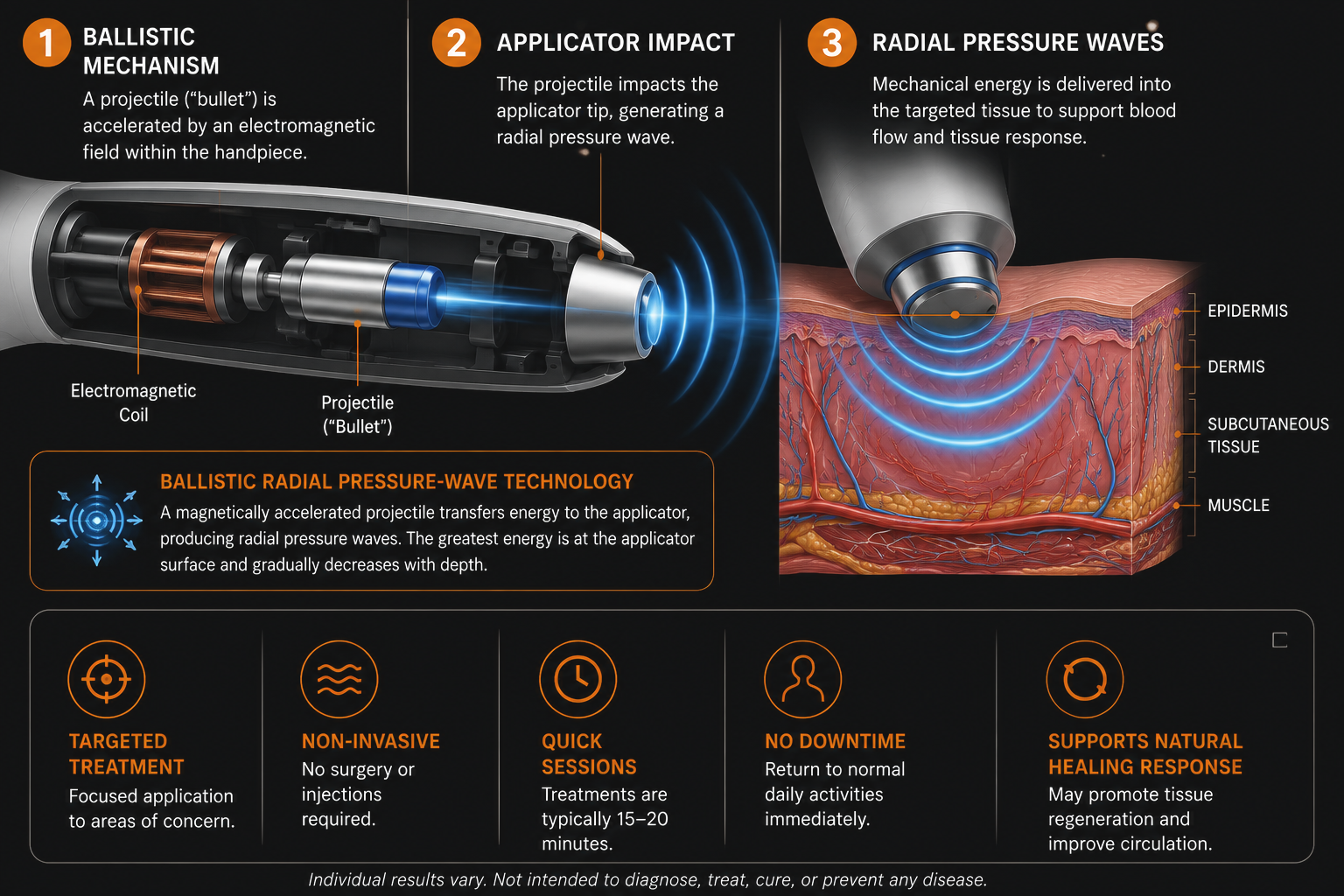
P-Wave uses low-intensity acoustic waves applied externally to the penile tissue. Similar forms of acoustic-wave therapy — sometimes referred to as low-intensity extracorporeal radial wave therapy (LI-ESWT) — have been studied for their effects on local circulation and tissue response in erectile dysfunction.
Proposed mechanisms include neovascularization (formation of new blood vessels), changes in local blood flow, and vascular tissue response. These mechanisms have been studied more extensively for erectile dysfunction than for other forms of male sexual dysfunction, though findings across studies are mixed.
Radial pressure-wave devices, like the one used for P-Wave, work through a different mechanism than focused radial wave devices. Evidence from focused-radial-wave studies should not automatically be assumed to apply to radial-wave therapy, and additional controlled clinical studies are needed to determine effectiveness, optimal treatment protocols, and durability of results.
What Does the Research Say About P-Wave?
Acoustic and other energy-based therapies have been investigated for erectile dysfunction, including low-intensity extracorporeal radial wave therapy (Li-ESWT) and radial pressure-wave devices. Some studies have reported improvements in erectile function scores, particularly in men with vascular erectile dysfunction.
However, research findings are mixed. At least one randomized, sham-controlled trial of radial pressure-wave therapy found no significant difference between the active treatment and sham treatment for erectile function. Treatment protocols also vary considerably across studies — including pulse count, frequency, and treatment schedule — and there is not yet enough high-quality evidence to establish which patients are most likely to benefit, the optimal treatment protocol, or how long potential benefits may last.
Erectile dysfunction is also multifactorial. Vascular, hormonal, neurologic, medication-related, and psychological factors may all contribute, and acoustic-wave therapy does not necessarily address every possible cause.
At R2 Medical Clinic, P-Wave is considered as one potential treatment option following an individualized evaluation rather than as a universal treatment for erectile dysfunction.
Potential Key Benefit
6-8
Sessions Recommended
15-20
Minutes Per Session
0
Anesthesia Required
0
Days Downtime
Stimulates New Blood Vessel Formation
Promotes angiogenesis for improved circulation to penile tissue.
May Support Erectile Firmness
Investigated for potential effects on tissue response and blood flow.
Combines with P-Shot
Can be paired with P-Shot therapy as part of a broader treatment plan.
Conditions Treated
What to Expect
Before
Your provider reviews your symptoms, medical history, medications, and other factors that may contribute to erectile dysfunction. This evaluation helps determine whether P-Wave may be appropriate.
During
Acoustic waves are applied to the penile tissue using a handheld treatment device. A typical session takes approximately 15–20 minutes. Anesthesia is generally not required.
After
Most patients can return to normal daily activities following treatment. Temporary sensitivity or discomfort may occur. Your provider will discuss the recommended treatment schedule and follow-up based on your individual treatment plan.
Who May Not Be a Candidate?
Is P-Wave Right for Everyone?
P-Wave is not necessarily appropriate for every man experiencing erectile concerns.
Erectile dysfunction may be related to:
- Cardiovascular and vascular disease
- Hormonal changes
- Diabetes and metabolic disease
- Neurologic conditions
- Medication side effects
- Peyronie’s disease
- Psychological or relationship factors
- Other medical conditions
Identifying these contributors may lead to treatments other than—or in addition to—P-Wave.
Alternative Treatments
Other Treatment Options
Depending on the cause of your symptoms, treatment may include medication adjustment, PDE5 inhibitors, testosterone therapy when clinically appropriate, PRP (P-Shot) therapy, counseling, or other individualized treatment approaches.
Learn more about our comprehensive approach to Male Sexual Dysfunction.
Frequently Asked Questions
Schedule Your Free Consultation
References & Medical Resources
- Sandoval-Salinas C, Saffon JP, Corredor HA, et al. Are Radial Pressure Waves Effective in Treating Erectile Dysfunction? A Systematic Review of Preclinical and Clinical Studies. Sexual Medicine. 2021;9(4):100393.
This systematic review specifically distinguishes radial pressure waves from focused radial waves and reviews their biological and clinical evidence in erectile dysfunction. The authors concluded that clinical evidence for radial waves was insufficient and that focused-radial-wave evidence should not simply be extrapolated to radial devices.
PubMed Central — Full Article - Sandoval-Salinas C, Saffon JP, Martínez JM, et al. Are Radial Pressure Waves Effective for the Treatment of Moderate or Mild to Moderate Erectile Dysfunction? A Randomized Sham Therapy Controlled Clinical Trial. Journal of Sexual Medicine. 2022;19(5):738–744. doi:10.1016/j.jsxm.2022.02.010.
This randomized, double-blind, sham-controlled trial evaluates radial pressure waves specifically, rather than focused Li-ESWT, in men with erectile dysfunction. It found no significant difference between radial-wave and sham treatment for erectile function — an important negative result when accurately characterizing the evidence.
PubMed — Radial Pressure Wave RCT - Corredor H, Sandoval-Salinas C, Saffon J, Gallego A, Uribe O. Effectiveness and safety of the radial pressure waves for the treatment of erectile dysfunction. A randomized clinical trial. Journal of Sexual Medicine. 2022;19(Suppl 2):S160. doi:10.1016/j.jsxm.2022.03.366.
This report describes radial pressure-wave treatment parameters in men with erectile dysfunction and again emphasizes that radial waves have a substantially different mechanism from focused radial waves, and that evidence from focused radial wave therapy cannot automatically be extrapolated to radial therapy.
academic.oup.com
Medically reviewed by Erik Natkin, DO — Founder, Medical Director, & Physician, R2 Medical Clinic. Content last reviewed August 2026.