Platelet-Rich Plasma (PRP) Therapy in Denver, CO
PRP is prepared from a patient’s own blood and used as a biologic treatment intended to support the body’s natural healing response.
Platelet-rich plasma (PRP) is prepared from a patient’s own blood and contains a concentrated number of platelets along with growth factors and other biologically active proteins involved in normal tissue repair. PRP is used in several areas of medicine as a biologic treatment intended to support the body’s natural healing response.
At R2 Medical Clinic, PRP may be considered for selected musculoskeletal conditions, hair restoration, aesthetic applications, and men’s and women’s sexual health. The evidence supporting PRP varies considerably by condition, and treatment recommendations should be individualized.
How PRP Works
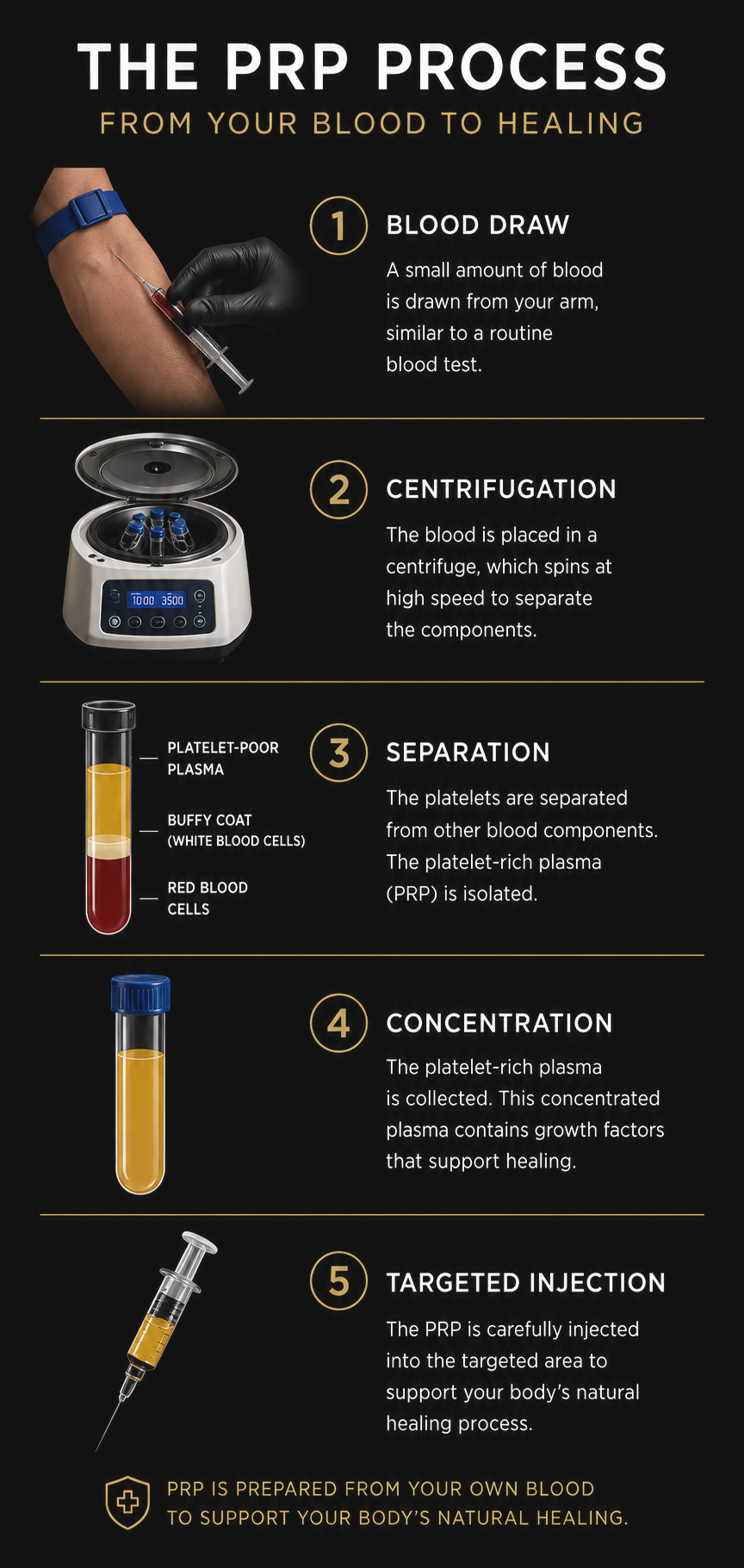
1. Blood Draw
A small sample of blood is drawn from your arm, similar to a routine lab test.
2. Centrifuge Processing
The blood is placed in a centrifuge that spins at high speed to separate the platelet-rich plasma from other blood components.
3. Concentration
The platelet-rich portion is separated and prepared for treatment, creating a plasma product with a higher platelet concentration than whole blood.
4. Targeted Injection
The concentrated PRP is injected precisely into the treatment area using image guidance when appropriate.
Benefits of PRP Therapy
Natural Healing
Uses your own blood, eliminating risk of allergic reaction or rejection.
Reduced Inflammation
Growth factors actively calm inflammatory processes.
Collagen Stimulation
Promotes new collagen production for skin and tissue repair.
Pain Reduction
Considered for chronic pain conditions that have not responded to other treatments.
Minimal Downtime
Most patients return to normal activities the same day.
Accelerated Healing
Supports recovery from injury and surgical procedures.
Applications
PRP therapy can be considered across a range of conditions and goals:
Joint Injuries
Knees, hips, shoulders, and ankles.
Tendon and Ligament Repair
Achilles, rotator cuff, tennis elbow.
Osteoarthritis
Reducing pain and improving joint function.
Sports Injuries
Recovery support for active individuals and athletes.
Hair Restoration
Intended to stimulate dormant hair follicles to promote regrowth.
Facial Rejuvenation
The “Vampire Facial” for skin tone, texture, and firmness.
Evidence Varies by Condition
Research into platelet-rich plasma has expanded considerably, but PRP should not be considered a single standardized treatment. Preparation methods, platelet concentrations, leukocyte content, injection protocols, and treatment indications vary among studies.
Evidence also differs substantially depending on the condition being treated. PRP has been studied extensively for certain musculoskeletal conditions, particularly knee osteoarthritis and some chronic tendinopathies, while evidence for other applications remains more limited or continues to evolve.
For this reason, whether PRP is appropriate should be based on the specific condition, available evidence, medical history, previous treatments, and individual treatment goals.
Frequently Asked Questions
Schedule Your Free Consultation
References & Medical Resources
- American Academy of Orthopaedic Surgeons (AAOS). Platelet-Rich Plasma (PRP). OrthoInfo.
Overview of PRP preparation, proposed mechanisms, clinical applications, potential benefits, and limitations of current evidence.
orthoinfo.aaos.org - American Academy of Orthopaedic Surgeons (AAOS). Platelet-Rich Plasma (PRP) for Knee Osteoarthritis Technology Overview.
Evidence review examining the clinical literature surrounding PRP for symptomatic knee osteoarthritis.
aaos.org - Fitzpatrick J, Bulsara M, Zheng MH. The effectiveness of platelet-rich plasma in the treatment of tendinopathy: a meta-analysis of randomized controlled clinical trials. American Journal of Sports Medicine. 2017;45(1):226–233.
doi:10.1177/0363546516643716 - Miller LE, Parrish WR, Roides B, Bhattacharyya S. Efficacy of platelet-rich plasma injections for symptomatic tendinopathy: systematic review and meta-analysis of randomised injection-controlled trials. BMJ Open Sport & Exercise Medicine. 2017;3:e000237.
doi:10.1136/bmjsem-2017-000237 - Donnelly C, Minty I, Dsouza A, et al. The role of platelet-rich plasma in androgenetic alopecia: a systematic review. Journal of Cosmetic Dermatology. 2024;23(5):1551–1559.
doi:10.1111/jocd.16185 - Zhang X, Ji Y, Zhou M, et al. Platelet-Rich Plasma for Androgenetic Alopecia: A Systematic Review and Meta-Analysis of Randomized Controlled Trials. Journal of Cutaneous Medicine and Surgery. 2023;27(5):504–508.
doi:10.1177/12034754231191461 - Evans AG, Mwangi JM, Pope RW, et al. Platelet-rich plasma as a therapy for androgenic alopecia: a systematic review and meta-analysis. Journal of Dermatological Treatment. 2022;33(1):498–511.
doi:10.1080/09546634.2020.1770171
Medically reviewed by Erik Natkin, DO — Founder, Medical Director, & Physician, R2 Medical Clinic. Content last reviewed August 2026.